

A raised access floor uses removable modular panels set above the structural floor, creating space for power and data cabling and, in some systems, air distribution. Anti-static flooring for server rooms in Colorado Springs helps control static charge, while the raised-floor system organizes services beneath the walking surface. They solve related but different problems, so the right design depends on the room’s equipment, wiring, and airflow needs.
Protecting sensitive electronics takes more than choosing a floor labeled “anti-static.” This guide explains how raised access floors work, why server rooms use ESD flooring, how conductive and static-dissipative resistance classes differ, and which flooring options may suit the space. It also covers installation quality and the questions to consider when planning anti-static flooring for server rooms in Colorado Springs.
Key Takeaways
- Match flooring suitability to the room’s equipment, cleanliness needs, wiring, and airflow requirements before choosing a system.
- Plan for professional resistance testing after installation and at intervals to help confirm the floor continues to perform within specification.
- Compare conductive, static-dissipative, and anti-static flooring by their resistance ranges and the level of static control the space requires.
- Weigh ESD protection alongside durability and maintenance needs to narrow down flooring options for a server room.
What Is a Raised Access Floor?
A raised access floor consists of removable modular panels installed above a building’s structural floor. The space beneath can route data cables and power lines and, in some systems, distribute air. In data centers and server rooms, this design keeps services accessible while reducing visible cable clutter and trip hazards. Technicians can lift selected panels to maintain or reconfigure cabling without opening walls or disturbing the entire floor.
Flooring suitability depends on how the room operates. A data center may need organized, high-density wiring, airflow management, and ESD control. A cleanroom has different priorities, including cleanliness practices, equipment, traffic, and static risks. The floor system and surface must suit those conditions together: a raised design alone does not meet cleanroom requirements. In either environment, consider the panels, the space below them, and how people and equipment move across the surface.
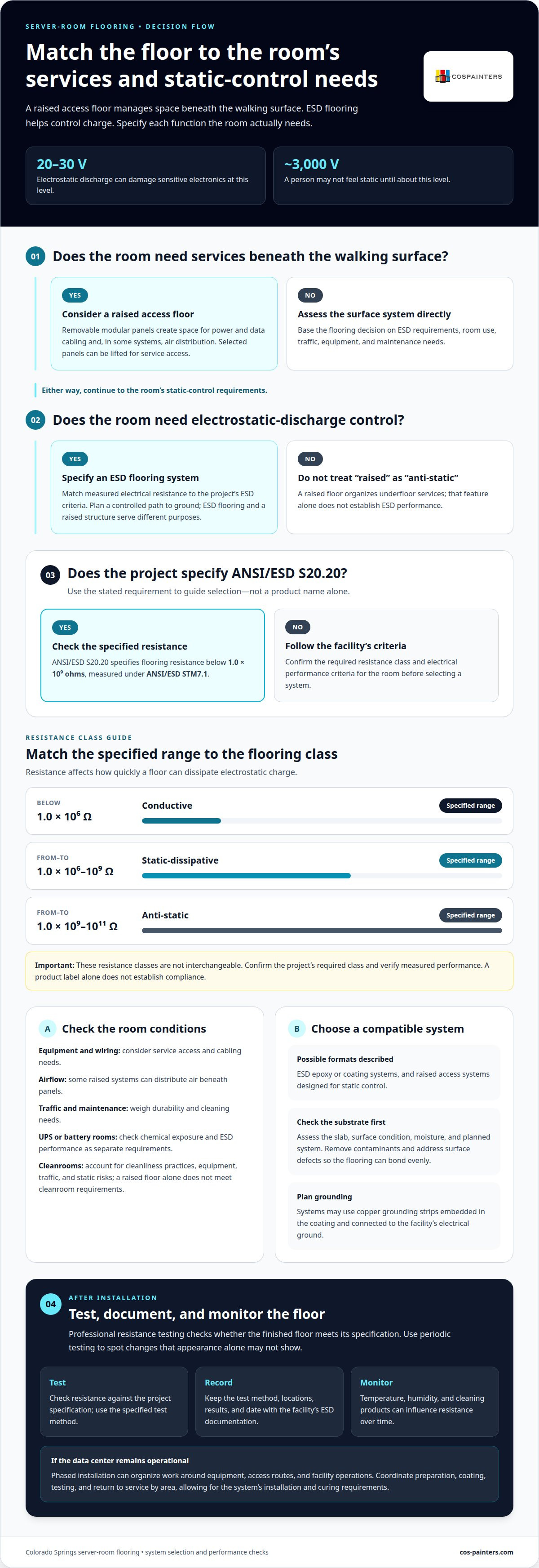
Static protection matters because sensitive electronics can be damaged by electrostatic discharge at 20 to 30 volts, while a person may not feel static until about 3,000 volts. ESD flooring helps provide a controlled path to ground, but it serves a different purpose from the raised structure. A server room may use a raised access floor for cabling and airflow, ESD flooring for charge control, or a coordinated system addressing both needs.
Emergency operations centers can also benefit from selective panel access for power and data system maintenance. For projects in Colorado Springs, applicable building and electrical grounding requirements depend on the facility and the work. Coordinate the flooring layout with those requirements, and connect ESD flooring to the facility’s electrical ground. Choosing anti-static flooring for server rooms in Colorado Springs starts with the equipment, traffic, wiring, airflow, and grounding design.
Why do data centers need anti-static flooring?
Electrostatic discharge can damage electronic components at 20 to 30 volts, even when people don’t feel a shock. ESD flooring helps control that risk by providing a path for charge to dissipate to ground. In electronics manufacturing and data centers, the flooring works as one part of an ESD control program, alongside grounding, suitable cleaning, and ongoing performance checks.
Before installation, a flooring professional assesses the existing slab, surface condition, moisture, and planned system. Preparation includes removing contaminants and addressing surface defects so the flooring can bond evenly. Dust, residue, moisture, or an uneven surface can interfere with adhesion and the finished result.
Grounding also needs careful planning. ESD flooring systems may use copper grounding strips embedded in the coating and connected to the facility’s electrical ground. Their placement and connection should suit the room layout and specified system. After installation, a professional tests electrical resistance against the project specification. Periodic testing can identify changes that might affect performance.
Temperature, humidity, and cleaning products can influence resistance over time, so use test results to guide routine monitoring and maintenance. The facility’s ESD plan can record test locations, readings, cleaning methods, and follow-up actions. This gives operations staff a consistent way to spot changes instead of relying on the surface’s appearance.
An operating data center may need phased installation to limit disruption. A professional can plan work zones around equipment, access routes, and facility operations, then coordinate preparation, coating, testing, and return to service by area. The sequence must account for the flooring system’s installation and curing requirements, since schedules vary by room and system.
Installation options include ESD coating systems and flooring designed for static control; the suitable approach depends on the substrate, traffic, and operational needs. For help planning a flooring project, explore professional flooring work.
Conductive, static-dissipative, and anti-static resistance classes
Server-room flooring options include ESD epoxy and raised access systems designed for static control. The right choice depends on the required resistance class, how the room is used, and the facility’s electrical performance criteria.
Resistance Classes and Electrical Performance
Resistance determines how quickly a floor can dissipate electrostatic charge. Conductive flooring has resistance below 1.0 × 10⁶ ohms; static-dissipative flooring ranges from 1.0 × 10⁶ to 1.0 × 10⁹ ohms. Anti-static flooring ranges from 1.0 × 10⁹ to 1.0 × 10¹¹ ohms. These classes aren’t interchangeable, so match the floor’s measured performance to the room’s ESD requirements.
ANSI/ESD S20.20 specifies ESD flooring resistance below 1.0 × 10⁹ ohms, measured under ANSI/ESD STM7.1. A product name alone doesn’t establish compliance. For example, when evaluating Marmoleum Ohmex, review the specified electrical resistance and flooring thickness against the project requirements rather than assuming its name establishes suitability.
Testing and Compliance Records
Resistance testing after installation shows whether the finished floor meets its specified electrical range. Periodic tests can identify changes over time, providing a more reliable performance check than appearance alone. Document the test method, locations, results, and date so readings can be compared and compliance records kept clear.
Keep test records with the facility’s ESD documentation. They help operations teams assess changes that may affect resistance, including cleaning practices and environmental conditions, and plan follow-up.
UPS and battery rooms add another selection factor: chemical exposure. The flooring system must suit the chemicals and cleaning products used in the room as well as its ESD requirements. Do not assume a chemical-resistant surface also provides the right electrostatic performance, or vice versa. Specify both requirements before choosing a system to help avoid unnecessary maintenance and operational downtime.
Anti-static and heavy-duty floor options
Choose a flooring system that matches static control to the room’s daily demands. A server room with sensitive electronics needs appropriate ESD performance, while equipment movement and foot traffic also affect surface requirements. Raised access systems come in anti-static and heavy-duty designs, allowing the floor structure and surface to address different operational needs.
ESD epoxy is one option for a continuous coated surface. With proper maintenance, ESD epoxy flooring can have a service life of 15 to 20 or more years. Its suitability depends on the substrate, installation conditions, cleaning routine, and the room’s static-control requirements. A coating should be considered as a complete system, not as a finish chosen by appearance alone.
Raised access systems offer a distinct advantage: removable panels provide access to services beneath the floor. In a data center, this can support cabling changes and underfloor air distribution. Heavy-duty designs may suit rooms where equipment and maintenance traffic place greater demands on the surface. Balance access needs and durability with the ESD performance specified for the facility.
Humidity also affects static control. A relative humidity range of 30 to 70 percent can help limit static buildup, while temperature and cleaning products may influence floor performance. The room’s operating conditions and maintenance practices therefore matter alongside the material. For example, a facility that uses particular cleaning products should account for their compatibility with its flooring system.
Electronics manufacturing typically requires static-dissipative flooring, while a server room’s needs depend on its equipment and ESD plan. Compare the required electrical performance, expected traffic, maintenance demands, and access needs before choosing a coating or modular system. This helps avoid a heavy-duty floor that misses static-control requirements, or an ESD system that lacks the durability the room needs.
To plan a floor that balances durability and static control, discuss your flooring project.
Colorado Springs Painters: Flooring
Colorado Springs Painters provides flooring for property improvement projects, including commercial spaces where durability and room function matter. For a server room, align the flooring choice with the facility’s static-control requirements, equipment traffic, cleaning practices, and access needs. A clear project brief helps define the flooring scope.
When planning a flooring project, Colorado Springs Painters can help account for the room’s practical requirements alongside the finished surface. Share how the space is used, what equipment moves through it, and which performance criteria guide your decision. This context helps focus the project discussion and define its scope.
For flooring help with your server-room project, contact Colorado Springs Painters.
Plan the Next Step for Your Server Room
A flooring decision is also a chance to plan for how the room may change. Consider whether equipment layouts, cable routes, or maintenance practices could shift, and include those needs in the project scope. This forward-looking approach connects the floor choice to facility operations, not just the current layout.
For anti-static flooring for server rooms in Colorado Springs, define the room’s use, traffic, cleaning needs, and required performance criteria before work begins. A clear brief gives the project practical direction and helps align the finished space with daily demands.
Colorado Springs Painters also offers interior painting, exterior painting, and commercial decorating for broader property improvement plans. If you’re ready to discuss flooring for your space, contact Colorado Springs Painters today. A thoughtful next step can help you move toward a space that’s ready for the work it needs to support.
Frequently Asked Questions
Why Work With an Experienced ESD Flooring Contractor?
An experienced ESD flooring contractor can coordinate substrate preparation, grounding details, installation, and resistance testing as parts of one project. Coordination matters when a server room must stay operational during work or contains UPS equipment and dense cabling. For example, work zones can be sequenced around equipment access, while test records help facility staff track readings and plan maintenance.
How do conductive and static-dissipative flooring compare for data centers?
Conductive flooring has resistance below 1.0 × 10⁶ ohms, while static-dissipative flooring ranges from 1.0 × 10⁶ to 1.0 × 10⁹ ohms. The difference is how each class manages electrical charge. A data center’s ESD requirements determine which range suits its equipment and operations; the flooring class should align with the facility’s specified performance, not simply a general “anti-static” label.
What electrical resistance standards apply to ESD flooring in server rooms?
ANSI/ESD S20.20 specifies ESD flooring resistance below 1.0 × 10⁹ ohms, measured under ANSI/ESD STM7.1. This provides a clear benchmark for assessing a floor’s electrical performance. In practice, compare the measured results with the project’s stated criteria and keep the test method and readings with facility records, so future assessments can use the same reference point.
Which contractors install anti-static flooring in Colorado Springs?
Colorado Springs Painters provides flooring work in Colorado Springs. For a server-room project, organize the scope around operational requirements, including static-control performance, equipment traffic, and access needs. This gives the flooring work a defined purpose and keeps the installation discussion focused on how the space functions.
How do professionals ground and test anti-static flooring after installation?
Grounding components connect to the facility’s electrical ground, and resistance is tested against the project specification. For example, the grounding design may include embedded copper strips. Test records should identify the method, measurement locations, and results, giving facility teams a useful baseline for future checks and a way to track changes across the floor.
How often should a professional clean and test ESD flooring in a server room?
Clean ESD flooring according to the facility’s routine and the surface’s approved cleaning requirements. Soil, traffic, and cleaning products can affect performance. Test resistance after installation and periodically, and plan additional checks if maintenance or operating conditions change. Keep cleaning and test records together so staff can relate changes in readings to products, work, or room conditions.


