
The most expensive brand label on a paint can won't protect your home if the underlying resin chemistry isn't built for high altitude. If you've watched your siding peel or your trim fade within just three to five years, you already know that choosing the best exterior paint for Colorado climate demands far more than off-the-shelf formulas. Between rapid freeze-thaw swings, bone-dry air, and relentless UV radiation that intensifies with elevation, ordinary coatings quickly turn brittle and crack.
Protecting your investment shouldn't mean repainting every few seasons. By matching advanced binder chemistries and thermal flexibility to your specific substrate, you can safeguard your home exterior for 10 to 15 years. In this guide, we'll explore the coating science required for the Rocky Mountain environment, examine how to prevent premature stucco and wood failure, and reveal the exact formulas engineered to endure our unique climate.
Key Takeaways
- Discover why pure acrylic latex resins with high volume solids represent the best exterior paint for Colorado climate, delivering the elasticity required for rapid 40-degree temperature swings.
- Learn how high-elevation UV radiation degrades paint binders and why selecting inorganic mineral pigments prevents premature fading on sun-drenched exterior walls.
- Identify the ideal coating systems for your specific siding, whether your home requires flexible, breathable masonry finishes for stucco or penetrating primers for cedar.
- Master the rules of Front Range application by monitoring actual substrate surface temperatures rather than ambient forecasts to ensure proper curing.
- Target vulnerable south-facing trim and weather-exposed joints during annual inspections to extend your coating lifespan up to 15 years.
Why the Colorado Climate Destroys Standard Exterior Paints
Front Range homes sit 6,000 feet or more above sea level, where a thinner atmosphere strips away the natural protection shielding building surfaces from extreme solar wear. Standard contractor-grade coatings designed for sea-level humidity fail rapidly under these conditions. Looking closely at what is paint made of helps explain the problem; basic vinyl-acrylic blends rely on balanced moisture levels to cure smoothly. In our semi-arid mountain air, solvents flash off before the film coalesces completely. Pinpointing the best exterior paint for Colorado climate starts with understanding how these unique atmospheric pressures systematically pull conventional coatings apart.
High-Altitude UV Radiation and Photochemical Breakdown
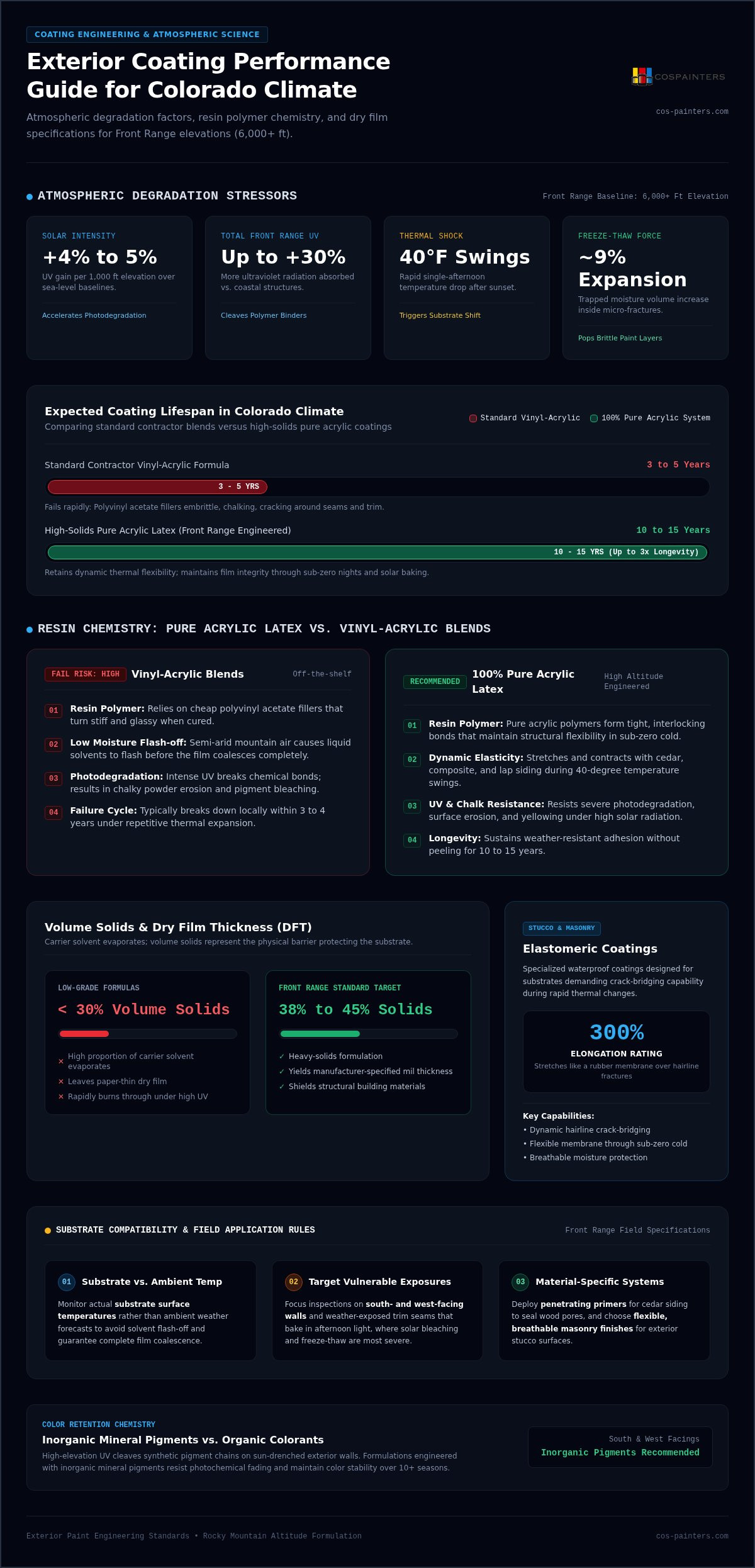
Solar radiation intensifies by roughly 4% to 5% with every 1,000 feet of elevation gain. Along the Front Range, residential siding absorbs up to 30% more ultraviolet radiation than coastal structures. Concentrated UV photons physically cleave the chemical polymers holding paint binders together, sparking an aggressive process known as photodegradation.
- Embrittlement: Broken chemical bonds leave the dried film stiff and glassy instead of flexible.
- Surface Chalking: As ultraviolet radiation erodes resin binders, loose pigment particles wash off as a chalky powder.
- Severe Pigment Bleaching: High solar exposure strips color vibrancy, especially on south- and west-facing walls that bake in afternoon light.
Thermal Shock and Freeze-Thaw Stress on Paint Films
Colorado is famous for rapid 40-degree temperature swings in a single afternoon. A sunny winter day can warm south-facing cedar or composite siding to 65 degrees, only for cold mountain air to drive surfaces well below freezing after twilight. This rapid swing causes immediate thermal shock. Wood and composite substrates expand under direct heat, then rapidly contract as temperatures plunge.
Rigid, low-grade coatings cannot stretch with this movement. Tiny micro-fractures quickly form around trim seams, lap joints, and uncaulked nail heads. When winter snow melts during midday, moisture seeps into these vulnerable gaps. As night falls and the trapped water freezes, it expands by roughly 9%, popping brittle paint right off the substrate. Selecting the best exterior paint for Colorado climate means choosing formulations engineered with dynamic elasticity to withstand this relentless physical stress.
The Best Exterior Paint Formulations for Colorado Homes
Achieving lasting protection against Rocky Mountain conditions comes down to resin chemistry. The best exterior paint for Colorado climate relies on premium binder elasticity and high-density solids to create a weather-resistant barrier that stays pliable through sub-zero nights and sweltering summer afternoons.
100% Acrylic Latex vs. Vinyl-Acrylic Blends
Resin elasticity makes the difference between a coating that lasts and one that fails quickly. Pure 100% acrylic latex resins maintain structural flexibility when winter temperatures plunge along the Front Range. Cheaper vinyl-acrylic blends rely on polyvinyl acetate fillers that turn glassy and fracture when building substrates shift. Pure acrylic polymers form tight, interlocking bonds that resist UV yellowing, surface erosion, and severe chalking. While vinyl blends often break down within three or four years locally, pure acrylic coatings expand and contract without peeling.
Understanding Volume Solids and Dry Film Thickness (DFT)
Paint consists of pigments, binders, and carrier solvents. Once liquid carriers evaporate during the curing phase, the volume solids represent the physical coating left behind, measured as dry film thickness (DFT). Inexpensive paints often contain under 30% volume solids, leaving a paper-thin film that burns through under direct sunlight. To survive high-altitude UV exposure, target formulas featuring 38% to 45% volume solids. Applying these formulas according to recognized industry standards ensures you achieve the proper mil thickness to shield structural materials. Investing in professional Front Range exterior painting ensures these heavy-solids coatings are applied at the exact manufacturer-specified depth.
When to Utilize Specialized Elastomeric Waterproof Coatings
Stucco and exterior masonry require exceptional crack-bridging capability. Elastomeric wall coatings provide up to 300% elongation, creating a flexible, rubber-like membrane that stretches over dynamic hairline cracks during rapid temperature swings. High-quality elastomerics feature breathable polymer structures, allowing internal moisture vapor to escape harmlessly without triggering blisters.
- Ideal Substrates: Traditional stucco, poured concrete, concrete masonry units (CMU), and brick facades.
- Substrates to Avoid: Wood lap siding, cedar shakes, and composite materials, which require micro-porous coatings to prevent trapped moisture decay.
Matching the Right Coating to Your Colorado Siding Material
One formula does not fit every home exterior. A coating that performs flawlessly on fiber cement can trigger peeling or blistering on traditional stucco or historic brick. Pinpointing the best exterior paint for Colorado climate requires pairing resin chemistry directly with the physical properties, moisture profile, and porosity of your specific siding.
Stucco Homes in Colorado Springs and the Front Range
Front Range soils are notoriously rich in expansive bentonite clay, creating minor structural settling that shows up as hairline stucco fractures. For stable stucco with minor micro-fissures, breathable flat 100% acrylic coatings provide exceptional durability while allowing internal humidity to escape. If your exterior exhibits active movement, elastomeric coatings provide the necessary stretch to bridge these gaps. Fresh stucco patches also require an alkali-resistant primer to prevent high pH masonry salts from chemically burning through the topcoat.
Engineered Wood, Cedar, and Fiber Cement Siding
Arid mountain air rapidly draws moisture out of natural wood, which leads to surface checking and grain cracking. Cedar and redwood siding also contain heavy concentrations of natural tannins that bleed through water-based primers under direct sun. Preparing these substrates requires a high-grade oil or hybrid stain-blocking primer before applying your acrylic finish coats.
- Fiber Cement: Products like James Hardie require 100% acrylic topcoats to maintain adhesion and honor manufacturer finish guidelines.
- End-Grain Sealing: Always prime raw field cuts, trim joints, and butt edges to prevent moisture from wicking behind the boards during snow accumulation.
- Substrate Stability: Proper surface sealing ensures the best exterior paint for Colorado climate bonds tightly across all engineered lap siding.
Exterior Brick and Stone Masonry Considerations
Clay brick and natural stone absorb moisture from rain, ground contact, and internal house vapor. Applying a standard, impermeable latex film traps that moisture beneath the surface. When Front Range temperatures drop below freezing, trapped water expands, blowing the decorative face off the masonry in a destructive cycle known as spalling.
Historic or unpainted brick demands highly breathable mineral silicate coatings. These formulations penetrate the masonry pore structure and chemically crystallize, creating an inseparable bond that never peels, blisters, or traps water vapor. Before applying any specialized masonry coating, wash surfaces thoroughly and neutralize all chemical cleaners to ensure complete chemical adhesion.
Application Guidelines: Managing Front Range Curing Conditions
Even the highest-grade resin formula will fail prematurely if applied outside its chemical curing envelope. Applying the best exterior paint for Colorado climate requires managing a delicate balance: low humidity accelerates surface flash-off, while sharp afternoon cooling halts binder coalescence before the coating forms an impermeable film.
Navigating Colorado's Rapid Temperature Swings
Ambient air temperature does not tell the whole story. Surface temperatures on shaded northern walls can linger 15 degrees colder than the air, while south-facing trim can easily exceed 110 degrees in unshielded mountain sun. When evening temperatures drop below 35 to 50 degrees Fahrenheit, standard latex emulsions stop coalescing, permanently weakening paint adhesion.
- Daily Application Windows: During spring and autumn, confine brush and spray work between 9:30 AM and 2:30 PM to grant applied films at least four hours of curing warmth.
- Sub-Zero Formulations: Utilize cold-weather exterior coatings chemically engineered to fuse down to 35 degrees Fahrenheit when shoulder-season weather turns unpredictable.
- Shade Following: Follow the sun around the structure, painting elevations just after direct sun passes to prevent rapid skinning and solvent entrapment.
Surface Preparation and High-Altitude Moisture Rules
Dry climates present deceptive moisture traps. After pressure washing, wood substrates require a full 48 to 72 hours of dry-out time, tested with a calibrated moisture meter to verify content sits below 15% before priming. Scrape all sun-baked, brittle layers down to sound wood, feather-sanding the transitions to eliminate jagged ridges. Seal every trim intersection, corner board, and window casing with high-movement elastomeric caulking capable of handling continuous substrate expansion.
Sheen Selection and Sun Reflection in Mountain Regions
High elevations experience intense, direct solar clarity that exaggerates every surface variation. Low-lustre and satin sheens provide the ideal compromise for siding, offering sufficient surface density to shed dirt and mountain dust without creating blinding glare. Reserve gloss sheens for front doors and architectural accents, while keeping broad stucco fields in flat or low-sheen finishes to mask substrate irregularities. If you want to ensure your property is coated under optimal regional curing conditions, schedule an exterior painting assessment with our local team.
Maximizing Paint Longevity on Your Colorado Springs Home
Even the best exterior paint for Colorado climate requires smart color choices and routine care to achieve a full 10- to 15-year service life. High-altitude elements test every seam and surface continuously. Proactive maintenance protects your investment, keeping your home looking vibrant and shielded against extreme Front Range weather.
Selecting UV-Stable Color Palettes for the Pikes Peak Region
Pigment chemistry plays a direct role in color retention under relentless mountain sun. Inorganic mineral pigments derived from natural iron oxides offer exceptional photostability. In contrast, vivid organic pigments such as bright reds, blues, and saturated yellows break down rapidly under ultraviolet exposure.
Muted earth tones, warm greiges, soft sage greens, and rich taupes harmonize with Front Range landscapes and neighborhood covenants while resisting rapid fading. Keeping an eye on Light Reflectance Value (LRV) matters too. Darker tones with an LRV below 50 absorb substantial solar heat, stressing wood and composite siding through thermal expansion. Lighter, reflective tones keep surface temperatures lower, extending coating elasticity.
Annual Maintenance Steps to Prevent Premature Failure
A simple walk-around each spring helps you catch minor issues before summer storms arrive. Direct your focus toward south- and west-facing fascia boards, window trim, and base siding near ground level.
- Clear Trim and Siding: Prune shrubs and landscape vegetation at least 12 inches away from walls to promote dry airflow and stop trapped moisture.
- Rinse Surface Dust: Perform a gentle garden hose wash each spring to remove alkaline road dust and environmental grit that abrades topcoats.
- Spot-Seal Joints: Recaulk drying joints and touch up localized bare spots promptly to prevent water from penetrating behind siding panels.
When to Call a Professional Front Range Painting Team
When paint begins flaking in large sheets, or bare wood and masonry show extensive weather erosion, simple touch-ups are no longer enough. Widespread failure signals that the original coating has lost adhesion down to the substrate, requiring full mechanical scraping, sanding, and specialized priming.
With over 25 years of local experience, our team understands the unique thermal demands and application chemistry needed along the Front Range. Reach out to Colorado Springs Painters to schedule a detailed exterior assessment and ensure your property receives the best exterior paint for Colorado climate applied with meticulous craftsmanship.
Build Lasting Protection for Your Colorado Home
Siding along the Front Range faces an uncompromising environment. Protecting your home requires pure 100% acrylic elasticity, substrate-matched primers, and careful attention to daily curing windows. When these technical components align, your exterior can easily endure a decade or more of high-altitude sun, heavy spring snows, and dramatic freeze-thaw cycles.
Choosing the best exterior paint for Colorado climate is only half the battle; meticulous surface preparation ensures that investment stands the test of time. As a locally owned team with over 25 years serving Colorado Springs homeowners, we specialize in high-altitude coatings applied through rigorous, multi-point surface preparation engineered for Front Range conditions. Schedule your high-altitude exterior painting consultation with Colorado Springs Painters today, and let us help you keep your home beautiful and resilient for years to come.
Frequently Asked Questions
How long does exterior paint typically last in the Colorado climate?
Exterior paint along the Colorado Front Range typically lasts 5 to 7 years in higher mountain areas and 7 to 10 years in lower foothills. In comparison, sea-level homes often reach 10 to 15 years between repaints. Rapid freeze-thaw cycles and severe ultraviolet exposure break down paint binders much faster here. Regular inspections, prompt recaulking, and using the best exterior paint for Colorado climate help extend that lifecycle significantly.
Is 100% acrylic latex paint really better than oil-based paint for Colorado homes?
Yes, 100% acrylic latex paint outperforms traditional oil-based coatings on Colorado exteriors. Oil-based finishes cure into a hard, rigid film that turns brittle when temperatures plummet below freezing. Acrylic latex remains flexible, stretching and contracting as siding expands under shifting mountain weather. Acrylic resins also resist photochemical breakdown from intense UV rays, whereas oil paints tend to oxidize, crack, and yellow quickly under elevation sunlight.
What is the best exterior paint sheen for intense high-altitude sunlight?
Satin and low-lustre finishes offer the best performance for Colorado exteriors. High-gloss sheens create harsh, blinding reflections and highlight every surface dent or natural siding imperfection under clear mountain light. Conversely, dead flat paints absorb moisture and collect airborne dirt more easily on lap siding. A quality satin sheen provides enough surface density to shed dirt while retaining sufficient flexibility and subtle light dispersion across your exterior walls.
Can you paint an exterior in Colorado when temperatures drop below 50 degrees?
Yes, you can apply paint in colder weather if you select specialized low-temperature formulas. Traditional acrylic paints require ambient and substrate temperatures of at least 50 degrees Fahrenheit to cure properly. Modern cold-weather coatings, however, allow safe application down to 35 degrees. You must ensure surface temperatures remain above this threshold for at least four hours following application so the film coalesces before nighttime freezing sets in.
Why is my exterior paint peeling only on the south side of my house?
South-facing exterior walls absorb the heaviest dose of daily ultraviolet radiation and suffer the sharpest thermal swings. During winter afternoons, south walls heat up dramatically in direct sun, only to plunge below freezing within minutes after sunset. This continuous expansion and contraction snaps rigid paint films. Selecting the best exterior paint for Colorado climate ensures your south-facing walls have the binder flexibility and UV blockers required to prevent premature peeling.
Do I need a special paint formula for painting a stucco home in Colorado Springs?
Yes, stucco requires breathable masonry paint or an elastomeric coating specifically engineered for masonry substrates. Colorado Springs stucco expands and contracts with changing weather, often developing fine hairline fissures. Standard acrylic siding paints can trap internal vapor or crack across surface shifts. High-build elastomeric coatings bridge dynamic hairline cracks, while flat, alkali-resistant acrylic masonry paints allow internal moisture to escape freely without bubbling.
What colors fade the fastest under Colorado's UV radiation?
Vibrant organic colors like bright reds, deep blues, canary yellows, and vivid greens fade the fastest in Colorado. Thinner high-altitude atmosphere permits aggressive UV penetration that easily breaks the chemical bonds in organic dyes. For lasting color retention, choose natural earth tones, warm taupes, greiges, and sage greens. These shades rely on inorganic iron oxide pigments, which remain exceptionally stable under intense high-elevation sunlight.


