
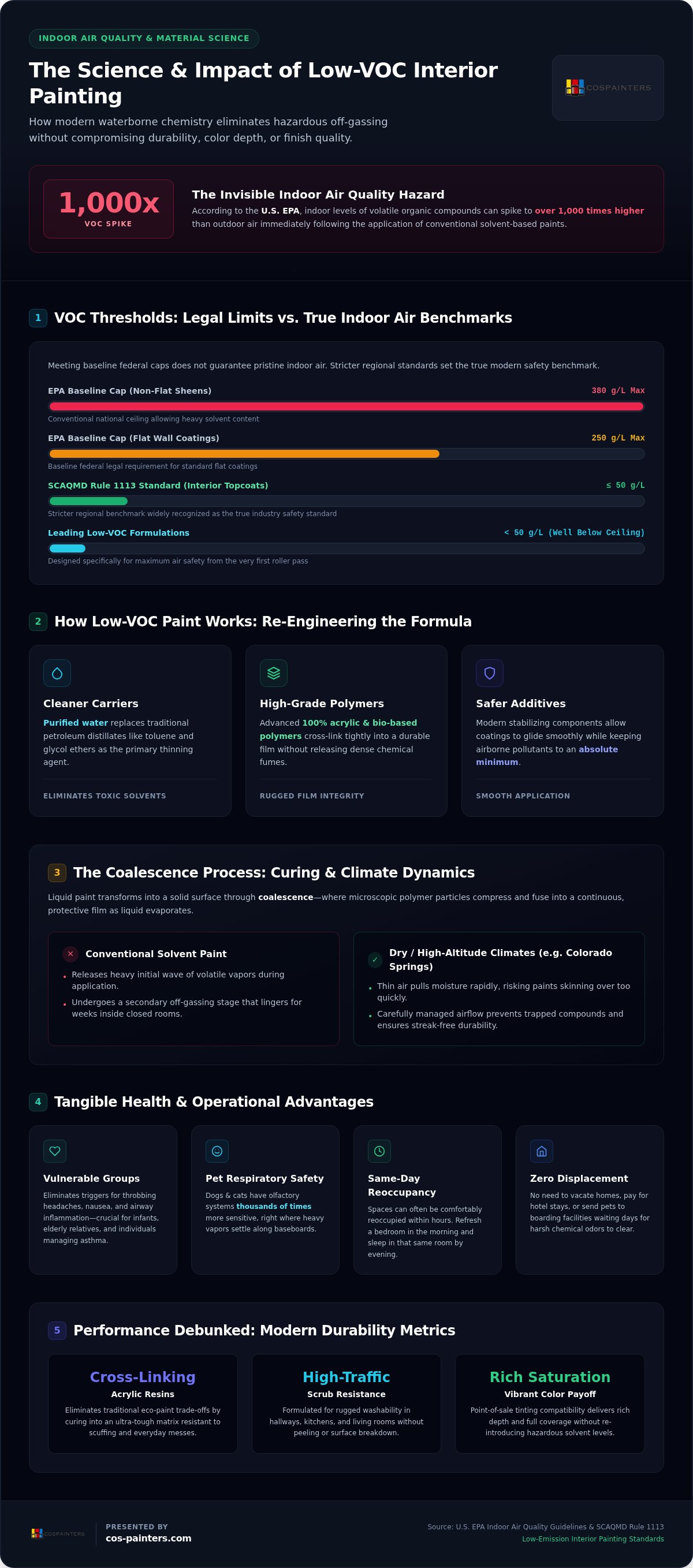
According to the U.S. EPA, indoor levels of volatile organic compounds can spike to over 1,000 times higher than outdoor air immediately after applying conventional paints. For decades, homeowners endured eye-stinging chemical odors and lingering headaches as the unavoidable tax on fresh walls. Today, low voc interior painting has rewritten that narrative, proving you don't have to compromise your household's respiratory health just to transform your living space.
If you feel skeptical about eco-friendly formulas, you're certainly not alone. Nobody wants to invest in a home update only to deal with finicky finishes that scuff easily, stain under real-life messes, or peel away after a few months. Modern coatings have completely closed that gap. You'll discover how low-VOC interior paints protect your family's indoor air quality without sacrificing vibrant color payoff or rugged scrub resistance. We will cut through greenwashed product labels, explore the chemistry behind durable finishes, and highlight what it takes to achieve a safe, flawless application in your high-traffic rooms.
Key Takeaways
- Discover how low voc interior painting protects your indoor air quality and keeps vulnerable family members safe from harsh, lingering chemical off-gassing.
- Learn the practical differences between low-VOC and zero-VOC ratings, including how point-of-sale tinting systems impact overall air safety.
- See how modern cross-linking acrylic resins eliminate traditional eco-paint trade-offs, delivering remarkable scrub resistance and rich color saturation.
- Understand the vital role of climate control and professional application in managing dry-air evaporation rates for a durable, streak-free finish.
What Is Low VOC Interior Painting and How Does It Work?
At its core, volatile organic compounds are carbon-based chemicals that evaporate easily at standard room temperature. For decades, manufacturers relied heavily on petroleum distillates like toluene and glycol ethers to keep pigments suspended and help liquid coatings spread evenly. Modern low voc interior painting fundamentally alters this chemical equation by replacing those harsh chemical carriers with purified water and advanced bio-based acrylic polymers.
When you update a room, low-emission formulations perform the same job without polluting your living space:
- Cleaner carriers: Water replaces petroleum-derived solvents as the primary thinning agent.
- High-grade polymers: Advanced 100% acrylic binders fuse tightly into a tough film without releasing dense chemical fumes.
- Safer additives: Modern stabilizing agents allow the paint to glide smoothly while keeping airborne pollutants to an absolute minimum.
The Chemistry of Off-Gassing in Enclosed Living Spaces
Liquid paint transitions into a solid surface through a process called coalescence. As liquid leaves the surface, microscopic polymer particles compress and fuse into a continuous, protective film. With conventional solvent paints, this transformation releases a heavy wave of vapors during application, followed by a secondary off-gassing stage that can silently linger for weeks inside closed rooms. In dry, high-altitude climates like Colorado Springs, thin air pulls moisture out fast. Without carefully managed indoor airflow, paints can skin over too quickly, trapping trace compounds inside the curing film and prolonging airborne irritation.
Regulatory Standards vs. Truly Safe Indoor Thresholds
National baseline limits enforced by the EPA allow up to 250 grams per liter (g/L) for flat wall coatings and 380 g/L for non-flat sheens. While these federal caps eliminate extreme solvent concentrations, meeting baseline legal requirements doesn't automatically ensure pristine indoor air quality. Stricter regional benchmarks, specifically South Coast Air Quality Management District (SCAQMD Rule 1113) standards, set the true industry bar at 50 g/L or less for interior topcoats. Leading low voc interior painting formulations aim well below even these regional ceilings, giving homeowners peace of mind from the very first roller pass.
Key Benefits of Low VOC Paint for Modern Living Spaces
Choosing low-emission coatings is about much more than general environmental responsibility. It directly transforms how you experience your living environment during and after a project. By replacing pungent synthetic solvents with cleaner alternatives, modern low voc interior painting turns what used to be a disruptive ordeal into a seamless home improvement.
Health and Air Quality Advantages for Growing Families
Traditional paint solvents release harsh fumes that routinely trigger throbbing headaches, nausea, and airway inflammation. For households with infants, elderly relatives, or individuals managing asthma, these fumes create genuine physical discomfort. Following established EPA indoor air quality guidance, swapping heavy petrochemical solvents for clean, waterborne coatings dramatically reduces airborne irritants in nurseries, bedrooms, and family gathering spots.
Four-legged family members benefit just as much. Dogs and cats have olfactory systems thousands of times more sensitive than ours, and their height places them right down near fresh baseboards and wall trim where heavier solvent vapors tend to settle. Cleaner formulations eliminate those harsh odors, protecting sensitive animal respiratory tracts from distress.
Operational Convenience and Faster Project Turnaround
Beyond personal wellness, modern low voc interior painting provides unmatched operational convenience. Homeowners no longer need to vacate their homes, pay for hotel stays, or send their pets to boarding facilities while waiting days for stinging chemical smells to clear. Because these advanced coatings dry without heavy fumes, treated spaces can often be comfortably reoccupied within hours of application.
This quick turnaround makes everyday home and business improvements simpler to coordinate:
- Flexible scheduling: Refresh a child's bedroom or primary suite in the morning and sleep comfortably in that same room by evening.
- Occupied renovations: Update busy living spaces, hallways, and common areas without interrupting normal household routines.
- Commercial productivity: Modern facilities and retail shops can execute commercial decorating updates without closing doors or losing valuable workdays to harsh fumes.
If you are planning an upgrade and want total peace of mind, partnering with experienced local interior painting specialists ensures a smooth, mess-free application that respects both your home and your schedule.
Evaluating Paint Labels: Low-VOC vs. Zero-VOC Formulations
Walking down the paint aisle can quickly become an exercise in deciphering marketing buzzwords. Under recognized industry benchmarks, a low-VOC designation indicates 50 grams per liter (g/L) or less. By contrast, a "Zero-VOC" label sounds absolute, but federal labeling regulations permit that title for any base formula containing under 5 g/L. The critical detail most homeowners miss is that these numbers almost always reflect the untinted white base straight from the factory, not the finished liquid rolling onto your walls.
Understanding the Colorant Trap in Custom Tinted Paint
Pick a moody navy, warm terracotta, or deep forest green, and you might accidentally reintroduce the exact chemicals you wanted to avoid. Historically, universal tinting dispersions relied on solvent-heavy glycols to keep concentrated pigments fluid. Adding several ounces of conventional tint into an ultra-clean base can easily drive the total VOC count back up to 50 or 100 g/L. When planning low voc interior painting projects, always ask the supplier if their dispensing equipment utilizes genuine zero-VOC waterborne colorants. That simple question ensures your chosen designer shade remains as safe as the plain white base.
Recognizing Reliable Third-Party Environmental Certifications
Independent testing certifications offer genuine transparency, cutting right through store-shelf greenwashing. Rather than trusting basic claims printed on the front of the can, look for seals from recognized testing bodies:
- Green Seal: The Green Seal GS-11 standard enforces a strict 50 g/L threshold that accounts for added colorants while prohibiting hazardous air pollutants, mutagens, and reproductive toxins.
- GREENGUARD Gold: Evaluates total chemical emissions inside dynamic environmental chambers over a multi-day curing period, ensuring coatings meet rigorous criteria for schools, nurseries, and sensitive spaces.
- Master Painters Institute (MPI) Extreme Green: Pairs low-emission chemical thresholds with strict performance benchmarks, proving the paint won't sacrifice adhesion, hiding power, or scrub resistance.
Checking for these verified emblems gives you confidence that your selected finish provides reliable air quality protection throughout its lifespan.
Performance and Durability: Debunking Common Eco-Paint Myths
Early eco-paints earned a frustrating reputation for chalking, streaking, and wiping right off the wall during routine cleaning. That outdated stigma still makes many homeowners hesitate. In reality, modern low voc interior painting relies on cross-linking acrylic polymers that form an exceptionally resilient, washable shield across your walls without depending on toxic solvent hardeners.
Coverage, Color Retention, and Sheen Considerations
Achieving rich color saturation no longer requires four coats and endless touch-ups. Today's premium eco-conscious formulations use finely ground mineral pigments suspended in high-density binders. This delivers remarkable hiding power that conceals existing dark wall colors cleanly.
Matching your room to the right sheen level provides long-term durability against active family life:
- Matte and Eggshell: Perfect for bedrooms, home offices, and living rooms. They soften glare while resisting normal handprints and scuffs.
- Satin: A versatile workhorse for active hallways and children's rooms that need frequent wiping down.
- Semi-Gloss: The gold standard for trim, baseboards, doors, and moisture-prone bathroom painting projects where water repellency is vital.
High-quality resins ensure everyday messes like crayon marks, sauce splatters, and muddy paw prints clean up effortlessly with a soft damp cloth, without burnishing or stripping away the underlying pigment.
Cure Time vs. Dry Time: Caring for Freshly Painted Walls
One common mistake homeowners make is confusing dry time with full cure time. Modern water-based formulas often feel completely dry to the touch in just two hours. However, polymer binders require up to thirty days to complete their microscopic cross-linking process and achieve maximum mechanical hardness.
In arid climates, thin dry air evaporates surface moisture rapidly. This quick dry creates the illusion that walls are fully cured within days. Scrubbing fresh paint too soon can mar the unfinished surface before it reaches its peak strength. Treat your new walls gently with plain water during that initial thirty-day window, giving the coating ample time to lock into place.
If you want a flawless, long-lasting finish backed by seasoned craftsmanship, schedule your interior painting project with our dedicated local team today.
Executing a Safe Interior Painting Project in Colorado Springs
Regional climate plays a massive role in coating performance. Sitting at an average elevation of 6,035 feet, Colorado Springs frequently experiences indoor humidity levels between 15% and 30%. In this thin, arid atmosphere, water carriers evaporate rapidly. Without careful airflow management, paint can flash-dry before it levels out, leaving visible roller ridges and brush marks behind. Successfully managing low voc interior painting in our dry climate requires balancing ventilation with controlled curing speeds.
Preparation Protocols and Dust Containment for Clean Air
Protecting your indoor air starts well before opening a paint can. Thorough prep work creates the mechanical profile needed for waterborne coatings to bond permanently, but messy sanding can easily degrade home air quality. Professional interior crews eliminate this issue through systematic containment:
- Zone isolation: Zip-wall plastic barriers and magnetic entry points seal work areas, keeping fine particulate out of your central HVAC ductwork.
- HEPA-filtered sanding: Modern dustless sanding equipment extracts drywall dust at the point of friction, keeping your living environment clean.
- Targeted low-VOC primers: Sealing patches and bare drywall surfaces with dedicated low-emission primers prevents moisture from being sucked out of your topcoat too quickly.
Why Work With Colorado Springs Painters for Your Interior
Managing Front Range curing challenges while prioritizing household wellness requires seasoned hands. With over 25 years of local residential and commercial experience, Colorado Springs Painters knows how to tailor low voc interior painting projects to our unique mountain climate. Our painters follow meticulous multi-step surface preparation protocols on every interior project, ensuring smooth leveling and long-term film adhesion without exposing your family to unnecessary airborne dust or fumes.
We take a consultative approach to every home we enter. Our team takes the time to walk you through verified low-emission product options, helping you match high-performance sheens and zero-VOC colorants to the specific demands of your household. Reach out to Colorado Springs Painters today to schedule a personal color and coating consultation for your home.
Create a Healthier, More Vibrant Home Today
Refreshing your living space shouldn't come at the cost of your household's air quality. Thanks to major advancements in resin chemistry and zero-VOC tinting systems, modern low voc interior painting lets you enjoy rich, scrubbable color without enduring days of throat-stinging fumes or weeks of silent off-gassing. When paired with proper surface preparation and an understanding of our unique Front Range climate, clean coatings deliver exceptional beauty that effortlessly stands up to everyday life.
Bringing that vision to life requires craftsmanship you can depend on. As locally owned and trusted residential specialists with over 25 years serving the Colorado Springs community, our team takes pride in doing things right from the ground up. Our crews combine careful dust containment with multi-step preparation standards to protect both your surfaces and the air your family breathes every single day.
Ready to refresh your living spaces with total confidence? Contact Colorado Springs Painters for a free estimate and take the first step toward a safer, beautifully renewed home.
Frequently Asked Questions
Does low VOC paint smell during application?
Low-VOC paint produces a faint, mild odor during application, but it lacks the sharp, solvent fumes of conventional paints. Most people describe it as a light, clean, or slightly chalky scent that quickly dissipates as the water carrier evaporates. Because these coatings emit minimal airborne irritants, you can comfortably remain in your home while rooms are painted without experiencing eye-stinging discomfort, nausea, or lingering headaches.
How long does low VOC paint take to fully cure?
While low-VOC paint feels dry to the touch within one to two hours, it takes up to thirty days to fully cross-link and cure. During this curing window, the polymer binder hardens into a durable, wash-resistant barrier. You can safely place furniture back against walls within a few days, but hold off on vigorous scrubbing, harsh household cleaners, or heavy hanging hardware until the full month has passed.
Are zero-VOC paints completely chemical-free?
Zero-VOC paints are not completely chemical-free, but they are dramatically cleaner than traditional options. Federal rules allow paints containing under five grams of VOCs per liter to carry a zero-VOC claim. Waterborne formulas still require mild preservatives, surfactants, and binders to prevent can spoilage and guarantee wall adhesion. For households with severe sensitivities, look for third-party certifications like GREENGUARD Gold to confirm ultra-low total chemical emissions.
Can low VOC paint be washed and scrubbed effectively?
Yes, modern low-emission paints deliver outstanding scrub resistance and washability. Manufacturers utilize 100% acrylic resin technology that creates a tough, non-porous film once fully cured. For high-traffic areas, choosing an eggshell, satin, or semi-gloss finish ensures that everyday scuffs, crayon marks, and grease stains wipe away cleanly with mild soap and water without removing color or leaving shiny burnished patches on your walls.
Does tinting paint with dark colors add VOCs back in?
Traditional tinting systems frequently add solvent-heavy colorants to white bases, reintroducing VOCs into deep or vibrant shades. Modern professional paint suppliers solve this problem by using zero-VOC universal colorants that maintain clean air standards regardless of pigment depth. When planning a low voc interior painting project with bold colors, always ask your contractor or paint provider to confirm their tinting dispensers use zero-VOC waterborne colorants.
Why do altitude and dry air affect interior paint in Colorado Springs?
Colorado Springs sits over 6,000 feet above sea level, where thin air and low indoor humidity cause waterborne paints to lose moisture very quickly. If paint flash-dries too fast, it cannot level out, leading to visible roller texture and lap marks. Successful low voc interior painting along the Front Range requires seasoned local painters who control indoor air movement, maintain proper temperatures, and apply paint with steady, deliberate efficiency.
Can low VOC paint cover existing dark wall colors in fewer coats?
High-grade low-VOC paints provide excellent hiding power, often covering existing dark colors in just two coats. Premium water-based formulas rely on dense concentrations of finely milled mineral pigments and superior acrylic binders rather than solvent fillers. When transitioning over deep reds, navies, or glossy surfaces, applying a dedicated low-VOC primer first ensures uniform color transition, perfect substrate adhesion, and a true-to-swatch finish without needing extra topcoats.


