
What if the lowest painting estimate leaves out the preparation your home needs? Comparing bids can be difficult when each painter describes a different scope of work, and a polished finish depends on more than color choice. Asking the questions to ask before hiring a painter in Colorado Springs can help you understand what’s included before you commit.
Before you choose a painter, get clear answers about protecting your property, preparing surfaces, selecting products, and completing the work. Ask about insurance, applicable local requirements, timing, and written terms, too. This checklist helps you compare proposals on the same basis, spot gaps in scope, and clarify expectations before signing. Focus on what the painter will do for your particular property, not just on broad promises or a price alone.
Key Takeaways
- Use the questions to ask before hiring a painter in Colorado Springs to compare contractor conversations and proposals.
- Ask for current proof of applicable insurance and check which local credentials or registrations may apply to the project.
- Request a surface-specific explanation of preparation, product choices, and how outdoor conditions may affect the work.
- Review the written estimate for included areas, exclusions, cleanup, scheduling assumptions, and payment terms.
- Compare proposals by scope and communication, then follow up wherever responsibilities or included work aren’t clear.
Questions to Ask Before Hiring a Painter in Colorado Springs
A consistent checklist makes it easier to compare painters in Colorado Springs on equal terms. The goal isn’t to find a universal “best” contractor or automatically choose the lowest estimate. It’s to understand who will do the work, which surfaces are included, and how the painter plans to handle the details that matter to your home or business.
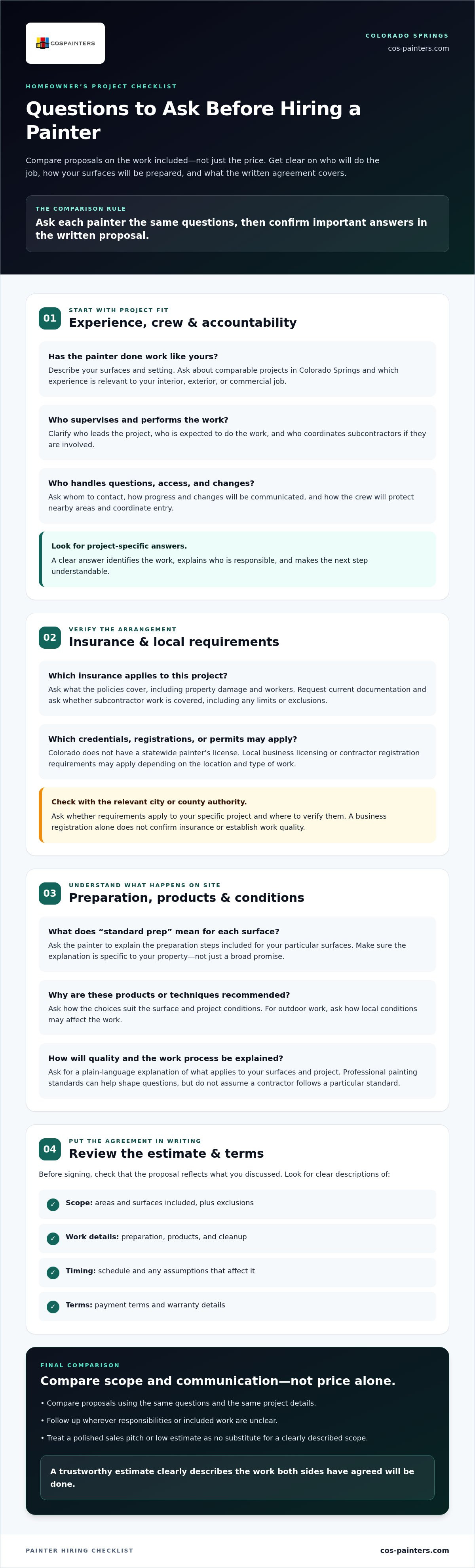
Use these questions to discuss experience, insurance, preparation, products, scheduling, and written terms. Ask for answers tied to your specific project. If a response doesn’t explain what will happen on your property, follow up before deciding. Then check that important details from the conversation appear in the written proposal.
Which questions reveal a painter’s experience and fit?
Ask whether the painter has completed projects similar to yours in Colorado Springs and who will supervise the work from preparation through completion. Experience with an interior room may not answer your questions about an exterior repaint or a commercial space. Describe the surfaces and setting, then ask which parts of the painter’s experience are relevant.
You can also request references or examples of comparable work. Respect for privacy is reasonable: a contractor may share photos or arrange a reference conversation only with a past client’s permission. The aim is to understand the fit for your project, not to expect access to someone else’s home. For a broader overview of the trade and its responsibilities, see this introduction to professional painters.
How can you tell whether an answer is clear?
Listen for details connected to your project. If a painter says “standard prep,” ask what that means for each surface and which steps are included. If they recommend a product or technique you don’t recognize, ask why it suits the surface and conditions. A useful answer identifies the work, explains who is responsible, and makes the next step clear.
Ask how the painter will communicate about access, progress, and changes. A broad promise such as “we’ll take care of everything” doesn’t define what you’re agreeing to. Follow up until the scope and responsibilities are clear, then confirm the written proposal reflects the discussion.
A trustworthy estimate clearly describes the work both sides have agreed will be done. That gives you a fair basis for comparing proposals without treating price or polished sales language as proof of quality.
Ask About Insurance, Credentials, and Who Will Do the Work
A proposal explains what a painter plans to do. Ask these next questions to understand who’s accountable and what documentation supports the arrangement. Request the same information from each contractor and compare the answers with the written scope. A confident response or business listing alone doesn’t confirm insurance or credentials.
What should you ask about insurance and credentials?
Ask which current insurance policies apply to your project, what they cover, and whether coverage includes property damage and workers. Request current documentation and check that the business and work described match the project you’re considering. If subcontractors may be involved, ask whether their work is covered and who can explain any limits or exclusions.
Colorado doesn’t have a statewide painter’s license, but local business licensing or contractor registration requirements may apply. Requirements can depend on the location and type of work, so check with the relevant city or county authority rather than relying on a general claim. Ask whether permits or registrations apply to your specific project and where you can verify that information. A business registration alone doesn’t confirm insurance or establish the quality of the work.
Who is responsible for the crew and communication?
Find out who will supervise the project, who is expected to perform the work, and whom to contact with questions or changes. If subcontractors are part of the plan, ask who directs their work and remains responsible for coordination. For an occupied home or business, clarify how the crew will protect nearby areas, arrange access, and communicate the day’s plan.
Ask how the painter will explain and document the work process. The PCA Industry Standards offer a reference point for understanding professional painting practices. Use them to shape questions about preparation, execution, and quality, rather than assuming a contractor follows a particular standard. Ask for a plain-language explanation of what applies to your surfaces and project.
- Insurance: Which policies apply, and can I review current documentation?
- Credentials: What local registrations or permits, if any, should I verify for this work?
- Accountability: Who supervises the crew and handles questions or changes?
- Access: How will the team coordinate entry and protect occupied areas?
These questions to ask before hiring a painter in Colorado Springs help make responsibilities clearer before work starts. If you’re gathering details for interior or exterior painting, you can discuss your painting project with a local company.
Ask How Preparation, Paint, and Local Conditions Shape the Job
A consistent finish starts with the work before the first coat. Ask the painter to explain preparation for each surface, then check that the same steps appear in the written scope. A list of paint brands doesn’t tell you whether the proposed work suits your property or how the crew plans to prepare the surfaces.
What preparation should the proposal describe?
Ask which surfaces will be cleaned, scraped, sanded, masked, and protected, and which of those tasks are included in the estimate. The right steps depend on the surface and its condition, so look for a project-specific explanation rather than a blanket promise of “full prep.” If the crew finds damage or needs to do additional work, clarify how it will be documented, discussed, and approved before the scope changes.
Separate painting preparation from repairs that aren’t included in the proposal. Ask what the painter will handle and what would require separate work or another contractor. The advice from the Federal Trade Commission offers further guidance on reviewing home-improvement estimates and agreements.
How should a painter address Colorado Springs conditions?
For exterior work in Colorado Springs, ask how strong local sun exposure, temperature, and seasonal weather may affect product recommendations and the work window. Ask which product characteristics suit the surfaces and exposure, and what conditions the manufacturer specifies for application. A familiar brand name is not a substitute for an explanation of why the product fits your project.
If the property was built before 1978, ask whether lead-safe considerations apply to the work and verify current guidance with the EPA. Don’t assume ordinary sanding or scraping procedures are appropriate for every older surface.
Surface preparation and conditions suited to the paint help create a more consistent finish and support its performance over time.
| Project type | Useful follow-up questions |
|---|---|
| Interior | How will floors, furnishings, and nearby surfaces be protected? What preparation is planned for each wall or trim surface? |
| Exterior | How will sun exposure and weather shape product choice and timing? Which exterior surfaces are included? |
| Commercial | How will the work sequence coordinate with access and building use? Which areas are included, and how will changes be communicated? |
These project-specific questions to ask before hiring a painter in Colorado Springs help show whether a proposal reflects your surfaces, setting, and priorities. Compare the answers with the written scope, and ask for clarification about preparation, products, or responsibilities that remain unclear.
Clarify the Written Estimate, Schedule, Payment, and Warranty
A written estimate should show what each painter is proposing so you don’t have to fill in gaps. Before signing, check that it describes the areas to be painted, preparation, products, exclusions, and cleanup. If a detail matters to your decision, ask to have it clarified in writing.
What should a painting estimate include?
Compare proposals line by line. Do they cover the same rooms or exterior surfaces? Do they describe similar preparation, paint products, and cleanup responsibilities? A phrase such as “paint interior” may not tell you whether trim, ceilings, or particular rooms are included. Ask the painter to clarify the scope so you can compare the same work.
Review exclusions, too. Ask how additional work would be described, priced, and approved before it begins. You don’t need to assume extra work will be required, but agreeing on the process now can prevent confusion if the crew finds an issue that changes the scope. Include what happens when the written plan needs to change among your questions to ask before hiring a painter in Colorado Springs.
How do you prevent misunderstandings after hiring?
Confirm the expected start date, work sequence, access arrangements, and how schedule changes will be communicated. Ask who can authorize a change and how approval will be recorded, such as in a revised written scope. Clarify payment milestones and what documents will show what each payment covers.
Discuss how belongings and occupied areas will be protected, where the crew needs access, and what cleanup is included when the work is done. Review any written warranty terms carefully. Ask what’s covered, what’s excluded, how long coverage lasts, and how to raise a concern. Don’t rely on a verbal assurance in place of terms you can review.
- Scope: Are included areas, preparation, products, exclusions, and cleanup clear?
- Schedule: Are the start-date assumptions, work sequence, access, and updates explained?
- Changes and payment: Are approvals and payment milestones documented?
- Warranty: Are coverage, exclusions, duration, and the process for concerns in writing?
Clear paperwork gives you a useful reference if questions come up during the job. If you’re ready to discuss an interior or exterior painting project and its written scope, contact Colorado Springs Painters.
Compare Painters in Colorado Springs and Choose Your Next Step
Once you’ve spoken with painters and gathered written proposals, compare the details side by side rather than relying on a quick impression. These questions are most useful when every contractor responds to the same project information. That makes gaps easier to spot and gives you a fair basis for follow-up.
How can you compare painting proposals fairly?
Use this process to organize your notes. A missing detail isn’t automatic proof of poor quality, but it is a reason to ask what the proposal means before you decide.
- Match the scope. Note which rooms, surfaces, or areas each proposal includes. Compare preparation, products, exclusions, and cleanup to make sure you’re considering the same work.
- Review the plan. Compare how each painter explains preparation for your project, the work sequence, and conditions that may affect timing or product selection.
- Check communication and supervision. Record who will oversee the project, who will answer questions, and how schedule updates or proposed changes will be handled.
- Review the documentation. Look for written terms covering payment milestones, change approvals, and any warranty. Ask for clarification if terms are missing or unclear.
- Consider references and examples. Ask for relevant references or examples of comparable work, while respecting past clients’ privacy. Compare how directly each painter answers your questions.
If one proposal describes surface preparation and another leaves it undefined, ask both contractors to explain their scope in writing. Clarify differences in responsibilities, exclusions, or products before treating the proposals as comparable. Keep a short list of unanswered questions and request specific answers instead of trying to interpret a vague phrase.
When are you ready to contact a painter?
You don’t need to have every decision made. Prepare the project location, the surfaces or areas you’re considering, a description of the work, your timing preferences, and the questions that matter most. Sharing these details helps start a useful conversation and makes it easier for the painter to understand what information is needed for a proposal.
Colorado Springs Painters is locally owned and operated, with painting work that includes residential and commercial interiors and exteriors. If you’d like to discuss your plans and ask project-specific questions, you can discuss a Colorado Springs painting project. You don’t need to have chosen a contractor already. A clear conversation can help you decide what next step makes sense for your project.
Choose Your Painter with Confidence
The right questions to ask before hiring a painter in Colorado Springs help you look beyond a polished pitch or a low estimate. Compare proposals by the surfaces and preparation included, clarify who’s responsible for the work, and make sure schedule, payment, changes, and warranty terms are documented. If an answer is unclear, ask for specifics before you sign.
A clear agreement gives you a shared understanding of the project and a practical reference as the work moves forward. Take time to review the details, then choose the painter whose scope and communication fit your needs.
Colorado Springs Painters is a locally owned and operated professional painting company. If you’re planning interior or exterior painting, discuss your Colorado Springs painting project and share the details you’ve gathered. A thoughtful conversation is a useful first step toward a project with clear expectations.
Frequently Asked Questions
Do painters need a license in Colorado Springs?
Colorado doesn’t issue a statewide painter’s license, but local business licensing or contractor registration requirements may apply. Ask the painter what credentials or registrations apply to your specific project, then confirm current requirements with the relevant City of Colorado Springs or El Paso County authority. Don’t treat a business registration as proof of insurance, experience, or workmanship. Requirements can depend on the work and location.
What insurance should I ask a painting contractor to carry?
Ask for current documentation of applicable general liability and workers’ compensation insurance, and confirm what each policy covers for your project. General liability may address certain property-damage claims, while workers’ compensation relates to employee injuries. Colorado requires painting businesses with one or more employees to carry workers’ compensation. Ask how coverage applies if subcontractors are involved, and verify details with the insurer rather than relying only on a verbal assurance.
What should a painting estimate include before I sign?
A clear estimate should describe the areas to be painted, preparation tasks, proposed products, exclusions, and cleanup responsibilities. Check that each proposal covers the same rooms or surfaces and explains the work in comparable detail. Ask how the schedule, payment milestones, and scope changes will be documented. Have vague terms clarified in writing before signing.
How many painter references should I check?
There’s no required number, but speaking with two or three recent clients, if the painter can provide them, may give you useful perspectives. Ask for references related to a project like yours, such as an interior repaint or exterior work. You might also request relevant project examples. Respect past clients’ privacy, and use references to ask about communication, preparation, cleanup, and whether the agreed scope was followed.
What should I ask about exterior painting in Colorado Springs?
Ask how strong sun exposure, temperature, and seasonal weather affect product recommendations and the work schedule. Find out what conditions are suitable for applying the proposed paint and how the painter will communicate weather-related adjustments. Discuss preparation for each exterior surface and confirm which areas are included. For older homes, ask whether lead-safe practices may apply, then check current EPA guidance for the property and planned work.
Should I get paint and preparation details in writing?
Yes. Ask the painter to put proposed products and preparation steps in the written scope so you can compare estimates accurately and know what you’re agreeing to. The scope should identify the surfaces involved and explain applicable cleaning, scraping, sanding, masking, and protection. If a product or preparation step is described vaguely, ask what it means for your project and request an updated written description before work begins.
What happens if a painter finds unexpected surface damage?
Ask the contractor to document the issue, explain what work may be needed, and describe how it could affect the agreed scope. Before any additional work proceeds, clarify how it will be priced and obtain written approval from the person authorized to make changes. Also ask whether the needed repair is included in the contractor’s services or requires a separate provider. Don’t assume extra work is automatically covered by the original estimate.


