

What if the calmest nursery isn’t the palest one, but the one where color, light, and paint choices work together? Creating a calming nursery with non-toxic paint Colorado Springs parents can feel confident about starts with understanding that “non-toxic,” low-VOC, and zero-VOC labels don’t necessarily mean the same thing. Even a carefully chosen paint still calls for thoughtful preparation and ventilation.
A soothing room can take shape with soft, muted colors that feel welcoming now and can grow with your child. Start by finding a palette that suits the room’s changing light, then review what paint labels and certifications say about emissions without treating them as a guarantee of health outcomes. This guide covers how to compare product claims, choose a cohesive nursery palette, and plan the repaint, from clearing and preparing the room to applying paint and airing it out before use. Colorado Springs Painters brings meticulous preparation and quality finishes to residential interior painting, helping turn a considered room plan into a finished space.
Key Takeaways
- Build a peaceful palette with muted colors that complement the nursery’s natural light and can suit the room as your child grows.
- Compare the specific product’s label and documentation rather than relying on broad claims alone.
- Choose paint and finish with the room’s surfaces and intended use in mind, and follow the manufacturer’s guidance for application and occupancy.
- Plan the repaint in order: clear and protect the space, prepare surfaces, paint as directed, and ventilate the room thoughtfully.
- Colorado Springs Painters brings meticulous preparation and quality finishes to residential interior painting, helping turn a considered nursery palette into a finished room.
Create a Calming Nursery Palette for Your Colorado Springs Home
A nursery palette should help the room feel peaceful and welcoming while reflecting your taste. Paint can support that atmosphere, but no particular color can guarantee better sleep or a specific response from your baby. Start with the feeling you want to create, then choose a shade that works with the room’s light, existing finishes, and furnishings. The best choice is one you’ll be happy to live with as the nursery evolves.
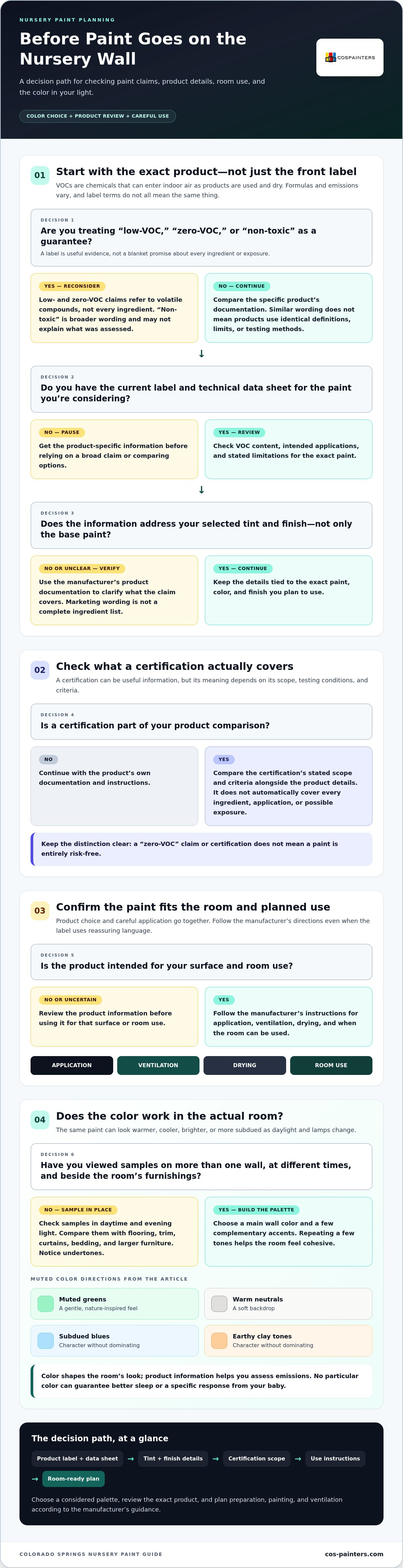
Muted greens can bring a gentle, nature-inspired feel; warm neutrals create a soft backdrop; and subdued blues or earthy clay tones add character without dominating the space. Keep color and product selection as related but separate decisions: the shade shapes the room’s look, while product information helps you assess emissions. For broader context on paint and environmental considerations, see Environmental impact of paint.
Choose nursery colors around the room’s light
Before settling on a color, notice how the room looks at different times of day. Morning daylight, afternoon sun, and evening lamps can each shift the appearance of a painted wall. Natural and artificial light can make the same paint color look warmer, cooler, brighter, or more subdued. A shade that looks balanced on a sample card may feel quite different across a full wall.
Test sample colors on more than one wall, especially if the room gets noticeably different light on each side. Look at them during the day and under the lighting you’ll use in the evening. Compare samples beside the flooring, trim, curtains, bedding, and larger nursery furniture. Check undertones as well: a cool gray-green may feel out of place beside warm wood, while a softer, warmer green could tie the pieces together. Judge colors in the room, not just in isolation.
Build a restful palette without overcomplicating it
Keep the plan simple: choose one main wall color, then add a few complementary accents through textiles, artwork, or furnishings. For example, muted green can pair with warm off-white trim and natural wood, while soft blue can sit comfortably with sand-colored details. Repeating a few tones helps the room feel cohesive. Too many competing accents or strong contrasts can make the overall design feel visually busy.
Consider where you want the eye to land. A consistent wall color gives patterned bedding or a favorite piece of art room to stand out. If you prefer more contrast, use it deliberately in a limited area rather than choosing a different bold shade for every wall. These are design choices, not rules for how a baby will sleep or feel. View your samples alongside the room’s fixed finishes and everyday furnishings before settling on a palette that feels considered and personal.
Understand Non-Toxic and Low-VOC Nursery Paint Labels
Paint labels can help narrow your options, but their terms don’t all mean the same thing. VOCs, or volatile organic compounds, are chemicals that can enter indoor air as products are used and dry. Paint formulas and emissions vary, so a broad claim on the front of a container may not tell you everything about a specific product. The EPA’s Volatile Organic Compounds (VOCs) and Indoor Air Quality page offers background on VOC sources and indoor air.
A paint label is useful evidence, not a blanket promise about every ingredient or exposure. Look beyond a reassuring phrase and review the details for the exact paint, color, and intended use.
What low-VOC and zero-VOC claims can tell you
Low-VOC and zero-VOC claims refer to volatile compounds, not every ingredient in a paint formula. The terms may use particular definitions, limits, or testing methods, so don’t assume two products with similar wording are identical. “Non-toxic” is broader wording and, without specific criteria or supporting documentation, may not explain which ingredients or emissions have been assessed.
Read the product label and current technical data sheet for the paint you’re considering. Look for VOC content, intended applications, and any stated limitations. Check whether the information applies to the base paint alone or also addresses the selected tint and finish. If a claim is unclear, use the manufacturer’s product documentation rather than treating marketing wording as a complete ingredient list.
How to assess paint certifications and product details
A certification can provide useful information, but its meaning depends on what was tested, the testing conditions, and the criteria used. It doesn’t automatically assess every ingredient, every way a product may be applied, or every possible exposure after painting. Compare certifications by reviewing their stated scope alongside the product’s own documentation. Don’t assume that a certification or a “zero-VOC” claim means a paint is entirely risk-free.
Before choosing, check that the product is intended for the surface and room use you have in mind. Review the manufacturer’s instructions for application, ventilation, drying, and when the room can be used. Follow those directions even if a label uses reassuring language. This product-specific review is more useful than relying on a broad claim alone.
Once you’ve selected a paint and reviewed its documentation, careful preparation and application help bring the nursery plan together. Colorado Springs Painters provides residential interior painting with meticulous preparation and quality finishes. Explore our Colorado Springs interior painting as you plan the room’s refresh.
Compare Nursery Paint Options for Color, Finish, and Room Use
Once you’ve shortlisted colors, compare the actual products rather than relying on one label or finish name. Water-based describes a category of paint, while low-VOC and zero-VOC are claims about specific emissions; finish describes the surface appearance and can affect maintenance. These attributes overlap, so a paint may be water-based, carry an emissions claim, and come in several finishes. Low-VOC wording alone doesn’t establish that a paint is completely non-toxic.
Use the product’s current label and technical data sheet to compare like with like. Suitability depends on the exact paint, the surface it will cover, how the room will be used, and the manufacturer’s directions.
| Option or feature | What to compare | Documentation check |
|---|---|---|
| Water-based paint | Intended surface, room use, appearance, and application needs. | Confirm the specific product’s directions and emissions information; “water-based” alone doesn’t describe every ingredient or emission. |
| Low-VOC or zero-VOC claim | The claim’s stated meaning and whether it applies to the exact product and selected tint. | Review the current label and technical data sheet for the basis and scope of the claim. |
| Matte or flat finish | A soft, low-sheen appearance that can make surface marks less prominent; consider cleaning expectations. | Check that the product is suitable for the surface and room use. |
| Eggshell, satin, or another sheen | More visible sheen than matte, with appearance and maintenance varying by product. | Confirm application instructions and intended use for walls, trim, or other surfaces. |
Match paint finish to the nursery’s surfaces
Think about each surface separately. A low-sheen finish may suit the look you want on walls, while trim may call for a different appearance or cleaning approach. Neither choice is automatically right for every family. Check that the selected paint is made for the surface, then weigh its care guidance against how the room will be used. Finish names can vary in performance across products, so compare documentation instead of assuming the label tells the whole story.
Use product documentation to compare paint options
Compare candidate products with the same checklist: emissions wording, intended surface, application directions, ventilation guidance, and room-use instructions. Check whether the documentation covers the selected color or tint as well as the base product, since tinting and formulations can affect product details. Follow the manufacturer’s current information for the exact paint you plan to use. A consistent comparison helps you choose based on documented properties, not a broad marketing phrase.
Prepare and Paint a Nursery Carefully in Colorado Springs
A considered paint choice is only one part of a thoughtful nursery repaint. A steady process helps protect the room’s contents, prepare the surface for a quality finish, and give the paint time to dry and cure according to its manufacturer’s directions. In Colorado Springs, don’t assume elevation or dry indoor air changes how every paint behaves. Use the instructions for the specific product and the conditions in the room.
Dry to the touch doesn’t necessarily mean ready for another coat or for the room to be used. Follow the product’s stated recoat and room-use guidance, not touch alone, when planning the nursery’s return to use.
Prepare the room and surfaces before painting
Begin by clearing the work area. Move nursery furniture and soft items out of the room where practical; cover anything that must stay, and protect floors, fixtures, and adjoining surfaces. Keep children away from the painting area, and follow the paint label’s safety directions throughout the work.
Next, assess the existing surface. Clean it as appropriate, then address minor imperfections with suitable patching, sanding, or primer where the surface and paint instructions call for them. Preparation depends on the wall’s condition and existing coating, so don’t assume every surface needs the same treatment. Remove dust after sanding and let cleaned or repaired areas dry as directed before painting.
Apply paint and allow for ventilation
Before opening the paint, review the label and technical information for the recommended application conditions. Check the specified temperature range, drying time, recoat interval, and ventilation instructions. These directions matter in Colorado Springs just as they do elsewhere, so don’t rely on a general rule about altitude or a dry climate in place of the manufacturer’s guidance.
Follow the application steps in the order the product requires. Allow the first coat the stated time before recoating, and avoid crowding the room with furniture while work is underway. Ventilate as directed, using the practical conditions of the space to support airflow without disregarding product instructions. Don’t assume that a low-emission label means ventilation can be skipped or that the nursery is ready for use as soon as the paint feels dry.
Once painting is complete, keep furniture, bedding, and nursery items out until the product’s drying and room-use directions allow them to return. Plan that timing before work begins, especially if you have a specific date in mind for setting up the room. If you’re preparing for a nursery repaint, schedule your interior painting project with Colorado Springs Painters. Our residential painting work emphasizes meticulous preparation and quality finishes, helping carry a carefully planned room through to completion.
Plan a Nursery Repaint with Colorado Springs Painters
A nursery refresh is easier to plan when you make the decisions in order: settle on a palette, review the chosen paint’s documentation, select a suitable finish, prepare the room, and follow the manufacturer’s application and room-use directions. This keeps design preferences and product considerations distinct while giving you a clear plan for the work.
Colorado Springs Painters provides residential interior painting with an emphasis on meticulous preparation and quality finishes. Our locally owned team brings more than 25 years of experience to helping homeowners turn a considered room plan into a carefully finished interior. A professional repaint can be a practical option when you’d like experienced help preparing and painting the nursery, without treating any paint choice as a guarantee about health outcomes or emissions.
What to plan before a nursery painting project
Before work begins, gather the decisions that shape the project: your preferred palette, which surfaces will be painted, the finish you want, and when you hope to set up the room. If you have specific paint requirements, identify them early and refer to the exact product’s label and technical data sheet. Application conditions, drying, recoating, ventilation, and room-use guidance should inform the project plan.
Surface condition matters, too. Existing finishes and imperfections can affect the preparation needed, so allow for a careful assessment of the areas being painted. Thoughtful preparation supports a clean, consistent result; the selected product’s directions help determine how it should be applied and when the room can return to use. Planning these details together can make the transition from an empty work area to a finished nursery more straightforward.
Take the next step toward a finished nursery
Once the color, product information, finish, and room timeline are clear, you’ll have a useful foundation for the repaint. Colorado Springs Painters brings careful preparation and attention to finish quality to residential interior painting, helping bring your chosen look together. If you’re ready to refresh your nursery, explore residential interior painting and take the next step toward a thoughtfully finished room.
Make Your Nursery Plan a Reality
A nursery takes shape through the choices that make it feel like home. As you plan the repaint, give yourself room to settle on a look and product details that feel right for your family, then set a realistic timeline for painting and room setup. A thoughtful plan can make the process feel more manageable and leave space to enjoy the finished room.
Colorado Springs Painters is locally owned and operated. Our residential interior painting emphasizes meticulous preparation and quality finishes, bringing care and craftsmanship to your home refresh. We help turn a nursery vision into a finished interior without promising that a particular paint choice guarantees a health outcome.
Ready to take the next step? Explore residential interior painting with Colorado Springs Painters and start planning a nursery that feels warm, peaceful, and truly yours.
Frequently Asked Questions
Is low-VOC paint the same as non-toxic paint?
No. Low-VOC refers to a claim about volatile organic compounds, while “non-toxic” is broader wording that can mean different things across products. Neither phrase by itself confirms that a paint has no emissions or ingredients of concern. Compare the current label and technical data sheet for the exact paint, review what any certification covers, and follow its application and room-use directions.
Can I paint a nursery while pregnant or with a baby at home?
Plan the work so the baby stays away from the painting area, and follow the product’s safety and ventilation directions. If you’re pregnant, ask your healthcare professional about personal exposure concerns before planning the work. Arrange another space for the baby and consider where household members will spend time while painting is underway. Use the product’s stated re-entry guidance rather than estimating from how quickly the surface feels dry.
How long should I ventilate a nursery after painting?
There isn’t one airing-out period that applies to every paint, room, and set of conditions. Use the specific product’s label and technical data sheet for ventilation, drying, and room-use directions. Plan furniture and bedding setup around those instructions, not just the time when the wall feels dry. If room conditions differ from those described by the manufacturer, follow the product guidance rather than relying on a generic timeline.
What paint color is most calming for a nursery?
No single color is calming for every family, child, or room. Muted greens, warm neutrals, soft blues, and gentle earth tones are possible starting points, but the room’s windows and existing furnishings affect the finished look. Test a sample in the actual space and view it at different times of day. Choose a color you enjoy; it’s a design preference, not a guaranteed way to change sleep or mood.
Is zero-VOC paint completely free of chemicals?
No. Zero-VOC wording relates to volatile organic compounds under the product’s stated definition or test method. It doesn’t mean the paint contains no chemicals or has no emissions. For a useful comparison, check the exact product’s documentation and what any certification evaluates. Keep the selected paint’s application and ventilation instructions with your project notes so they’re available while work is underway and as you plan to use the room.
Does Colorado Springs elevation affect how nursery paint dries?
Elevation alone doesn’t provide a reliable drying-time estimate for a particular nursery project. Product formulation and jobsite conditions matter, so check the manufacturer’s stated temperature, humidity, ventilation, and recoat guidance. In a Colorado Springs home, compare the room’s actual conditions with the product’s instructions rather than assuming local elevation or dry air changes every paint in the same way. Don’t apply another coat until the stated recoat guidance allows it.
Should I hire a professional to paint a nursery?
Hiring a professional is one option if you’d like help with surface preparation and paint application. Colorado Springs Painters provides residential interior painting with attention to preparation and finish quality. The room’s condition and the product you select still shape the project plan, including its application and room-use directions. Keep those product instructions central whether you paint yourself or arrange professional help.


