

Dry air can affect laminate before the first plank is laid. The fiberboard core responds to temperature and humidity, so learning how to acclimate laminate flooring in a dry climate starts with letting the sealed cartons sit in the installation room for 48-72 hours while indoor conditions stay steady.
It’s easy to focus on the flooring, but the room matters too. In a dry climate, temperature and humidity changes can affect laminate before and after installation. Preparing the space and following the product instructions gives the planks a better chance to adjust before they’re laid.
This guide explains why acclimation matters, how to manage room conditions, and where to place cartons while the flooring adjusts. You’ll also learn what to check before installation so you can prepare the room carefully and avoid rushing the process.
Key Takeaways
- Give sealed laminate cartons time to adjust in the room where they’ll be installed, rather than moving them straight from storage to the floor.
- Keep indoor conditions steady before and during acclimation; sudden shifts in temperature or humidity can affect the flooring’s fiberboard core.
- Use the flooring maker’s temperature and humidity requirements as your guide, since recommended ranges can vary by product.
- Plan the room and carton placement ahead of installation so the flooring has a stable, suitable space to acclimate.
Why does laminate flooring need to be acclimated?
Laminate has a wood-fiber core that responds to changes in temperature and humidity. Keeping the room’s conditions stable helps the planks adjust before installation and reduces movement after they’re laid.
- Keep room conditions steady. Maintain a consistent room temperature and relative humidity before you install. A common range for laminate is 65-85°F and 35-65% relative humidity, though product instructions can differ. The U.S. Environmental Protection Agency says indoor humidity is ideally between 30 and 50 percent to prevent mold. That guidance addresses indoor mold, while the flooring maker’s requirements govern the laminate.
- Account for winter conditions. Dry air can encourage the core to contract; added moisture can contribute to expansion. In ordinary winter weather, indoor humidity of 35-40% is recommended for laminate. During a hard freeze, humidity may need to fall toward 30% or slightly lower to balance flooring needs with window condensation risk. For outdoor temperatures of 20-40°F, keep indoor humidity under 40%; colder conditions call for lower levels.
- Leave cartons sealed. Acclimate laminate in its unopened packaging in the room where it will be installed, unless the manufacturer’s instructions say otherwise. Sealed cartons let the flooring adjust without exposing planks unnecessarily to room air. Keep packages flat, away from exterior walls, vents, radiators, and damp areas. Don’t lean boxes vertically or store them in a cold garage.
- Measure both the air and subfloor. Use a hygrometer to track relative humidity and a moisture meter to assess the subfloor. A concrete reading should not exceed 3% when checked with a concrete moisture meter; wood subfloors should read at or below 12%. These checks help identify moisture conditions that room humidity alone won’t reveal.
- Allow for material differences. Engineered hardwood typically needs 3-7 days to acclimate, while SPC vinyl typically needs 24-48 hours. Laminate timing varies by product, so follow its packaging instructions. In a heated home, keep climate control operating at normal living conditions before and during acclimation.
Maintaining a suitable room temperature
- Bring the installation room to a steady temperature. Keep the home’s heating or air conditioning running at normal living settings. Laminate should adjust to the environment it will experience after installation, not a temporary burst of heat. A stable temperature also helps limit rapid changes that can affect the flooring’s dimensions.
- Use the product’s temperature range. Requirements vary: Swiss Krono laminate calls for 64-86°F during acclimation, while another common recommendation is 65-85°F. A separate guideline suggests 60-80°F for flooring stability. These ranges aren’t interchangeable specifications, so use the instructions for your exact product.
- Prepare the room before delivery. One procedure calls for keeping the room between 65°F and 75°F for at least 48 hours before delivery and throughout acclimation. Start climate control early, rather than heating a cold room only after cartons arrive. This gives the room time to reach a consistent condition.
- Keep climate control operating. Run the home’s HVAC at normal living temperature for at least 48 hours before and after installation. Avoid switching the heating off overnight or raising it sharply during the day. In a heated home, gradual, steady operation is more useful than short cycles of extreme warmth.
- Account for under-floor heating. If radiant heating is present, follow the flooring maker’s specific procedure. One recommendation calls for a comfortable setting for at least 48 hours during acclimation. Avoid placing cartons near heating vents or other direct heat sources, which can create conditions unlike the rest of the room.
- Keep the whole room consistent. Close exterior doors and windows during acclimation, and keep cartons in the room where they’ll be installed. Check the temperature in the flooring area, not only beside a thermostat. A cold corner or warm air outlet can create uneven conditions that affect how planks expand or contract.
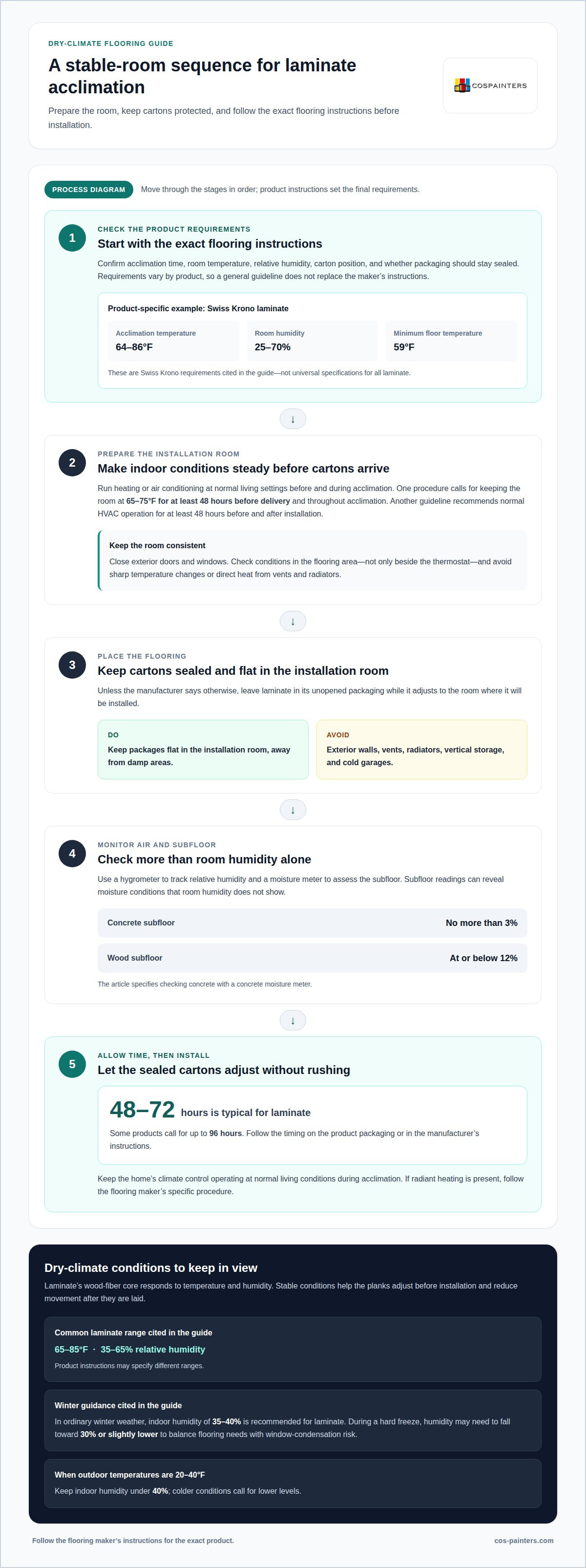
What humidity and temperature do laminate makers require?
Laminate typically needs 48-72 hours to acclimate, with cartons kept in the installation room. Some products call for up to 96 hours, so the maker’s instructions set the final timing.
-
Read the Manufacturer Instructions
Open the installation instructions for the exact flooring before arranging delivery or installation. Find the sections covering acclimation time, temperature, relative humidity, carton position, and whether packaging stays sealed. For example, a stated minimum of 48 hours is a product requirement, not a universal rule. Don’t rely on a general laminate guideline when the instructions give a different procedure.
-
Confirm Manufacturer Acclimation Requirements
Identify the product name and model, then match them to the maker’s acclimation guidance. Swiss Krono laminate, for example, calls for room humidity between 25% and 70% during acclimation, and a floor temperature of at least 59°F. These limits belong to that maker’s guidance, not every laminate product. Check the stated conditions alongside the required acclimation period.
- Review the warranty terms. Read the warranty and installation instructions before work begins. Look for requirements about acclimation, subfloor moisture, and room conditions. Keep these documents with the flooring details so the installer can follow the correct specifications. Requirements vary by product, so don’t assume another brand’s terms apply.
- Use the instructions to plan the installation. Check whether cartons should remain sealed and when the manufacturer recommends opening them. Look for guidance on room preparation, plank placement, and the locking edges. Note the required acclimation period and room conditions, then schedule installation once they are met.
Acclimating flooring in a dry climate
Dry air makes preparation especially important because laminate’s wood-fiber core can shrink as it adjusts. To understand how to acclimate laminate flooring in a dry climate, start by preparing the room and subfloor, then follow the flooring manufacturer’s instructions.
- Finish moisture-producing work first. Install permanent doors and windows, and complete wet construction tasks before bringing flooring into the room. Allow those tasks to cure. Otherwise, conditions may shift after acclimation begins, leaving the boards to adjust to a different environment.
- Confirm the subfloor is dry. Check the concrete or wood surface before placing cartons or installing planks. A damp subfloor can introduce moisture from below, even when a hygrometer shows low relative humidity in the room. Acclimation won’t correct a wet or damp surface.
- Move cartons into the installation room. Keep packages in the exact room where the flooring will go, not a garage, porch, or another space. A cold garage can expose boards to different conditions. If cartons were stored there, leave them in the installation room for at least 48 hours before installation.
- Arrange cartons for airflow. Lay boxes flat and leave about 1-2 cm between them. Keep stacks away from exterior walls, radiators, vents, and direct heat. This allows room air to circulate without concentrating heat on the boards.
- Track room conditions. Place a hygrometer in the installation room and observe relative humidity during acclimation. Keep doors and windows closed, and avoid abrupt heating changes. Stable readings are more useful than sudden attempts to change humidity or temperature.
- Follow the product’s timing. Keep cartons sealed unless the manufacturer directs otherwise. Many products need 48-72 hours, while some require up to 96 hours. For anyone planning how to acclimate laminate flooring in a dry climate, the product’s instructions and room conditions should guide the schedule. For installation support, explore laminate flooring installation.
Colorado Springs Painters: Flooring
Colorado Springs Painters provides flooring installation as part of property improvement projects. If you’re planning laminate flooring alongside other updates, first prepare the room and review the manufacturer’s requirements, then contact the team to discuss your flooring project.
When you’re ready to move from preparation to installation, Colorado Springs Painters can handle flooring as part of a larger project, alongside interior or exterior painting and commercial decorating. Coordinating the work helps each part of the update fit the room and the finished space.
For help planning flooring work, contact Colorado Springs Painters.
Plan the next step with confidence
Plan your flooring project by choosing the laminate, preparing the room, and scheduling installation around the manufacturer’s requirements. Knowing how to acclimate laminate flooring in a dry climate gives you a practical starting point. The next step is to plan the installation and create a finished space that suits your home.
If you’re ready to plan flooring work in Colorado Springs, contact Colorado Springs Painters to discuss installation. Flooring can also be part of a larger residential or commercial update, with the work planned to suit the space as a whole.
Share what you’re planning and take the next step at a pace that feels right for your project. Contact Colorado Springs Painters to discuss your flooring plans, and move forward with confidence.
Frequently Asked Questions
What happens if I skip acclimation?
Skipping acclimation means installing planks before they have adjusted to the room’s conditions. As their fiberboard cores respond to temperature and humidity, the flooring can change dimensions after installation. That movement may contribute to visible gaps, raised edges, or stress on the locking joints. Keeping the indoor environment stable before installation helps limit sudden changes once the floor is in place.
How much humidity should you run in winter?
Choose indoor humidity based on outdoor temperature and the flooring maker’s requirements. The Center for Energy and Environment recommends keeping indoor humidity under 40% when outdoor temperatures are 20-40°F, under 35% at 10-20°F, under 30% at 0-10°F, and under 25% below 0°F. These limits also help manage window condensation in cold weather.
What Is Acclimation and Why Is It Necessary?
Acclimation is the period when packaged flooring adjusts to the temperature and humidity of the room where it will be installed. Laminate has a core made from natural wood fibers, so its dimensions respond to environmental changes. Allowing time for adjustment helps prevent installing planks in conditions that differ sharply from those they’ll experience during regular use.
Will winter gaps close on their own?
Seasonal humidity changes can affect plank dimensions, but don’t assume gaps that appear in winter will close on their own. The cause matters: dry conditions can contribute to shrinkage, while installation or subfloor issues require a different fix. Keep the room’s conditions stable and observe whether the gap changes as seasons shift. Avoid forcing planks together, which can strain the locking edges.
What temperature and relative humidity are required to acclimate laminate flooring?
Use the exact product instructions because acceptable conditions differ by maker. For example, Swiss Krono specifies a room temperature of 64-86°F and relative humidity of 25-70% during acclimation. Other laminate products can have different ranges, so don’t treat one brand’s limits as universal. Check the temperature and humidity requirements together, since meeting one range alone doesn’t establish suitable room conditions.
How should laminate flooring be stored and stacked during acclimation?
Keep cartons sealed, flat, and inside the room where the flooring will be installed, unless the maker instructs otherwise. Leave about 1-2 cm between boxes for airflow, and keep stacks away from exterior walls, vents, radiators, and damp concrete. Don’t lean cartons vertically or put them in a garage, basement, or porch, where conditions may differ from the installation room.


