

Engineered hardwood may move less than a similar solid plank, but it is not immune to winter gaps. In Colorado Springs, preventing gaps in hardwood floors in winter starts with understanding how dry indoor air makes wood contract and how steady humidity can help limit that movement.
Small gaps that appear during a dry winter and become less noticeable when humidity rises may be normal seasonal movement. It’s understandable to worry when boards pull apart, but the size, pattern, and seasonal changes in the gaps help distinguish ordinary contraction from a flooring concern that needs attention.
This article explains when winter gaps are normal, what to look for if they persist, and how Colorado’s climate affects hardwood. You’ll also learn how acclimation and moisture testing before installation help prepare flooring for a home’s conditions, while recognizing that neither can eliminate all seasonal movement.
Key Takeaways
- Track when gaps appear and whether they change with the seasons; irregular gaps or boards that lift, split, or cup may need a flooring assessment.
- Keep indoor humidity steady. The U.S. Environmental Protection Agency recommends keeping it below 60 percent RH, ideally 30 percent to 50 percent if possible.
- Before installation, acclimation and moisture testing should account for the flooring construction, installation method, and subfloor.
- Colorado’s heated winter air can dry hardwood, so managing indoor conditions helps limit movement, though seasonal changes may still occur.
1. What Is the Difference Between Seasonal Gaps and a Flooring Problem?
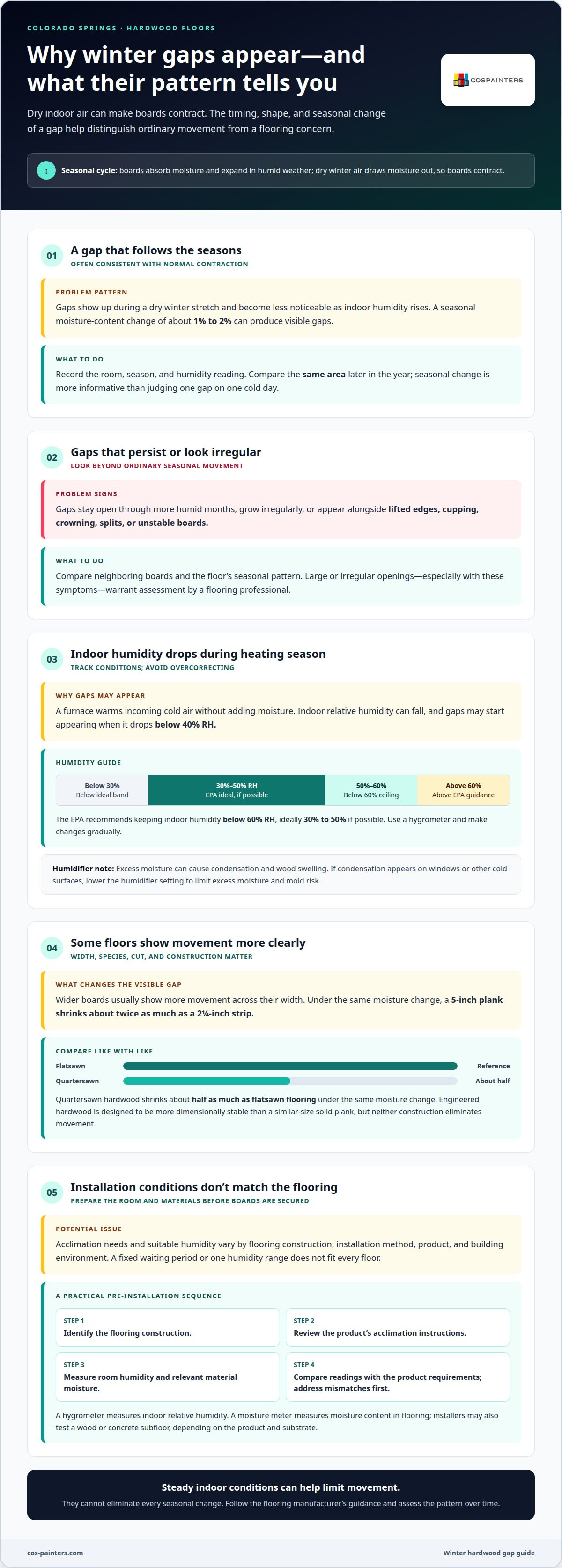
Hardwood flooring responds to moisture throughout the year. In humid summer weather, boards absorb moisture and expand; during a dry Colorado winter, they lose moisture and contract. This seasonal movement can open narrow spaces between boards, which may become less noticeable as indoor humidity rises. A gap that follows this pattern is often normal, not automatic evidence of failure. Preventing gaps in hardwood floors in winter in Colorado Springs starts with understanding this seasonal cycle.
To assess a floor, record when gaps appear and whether they change by summer. Compare the same area across seasons; gaps that persist through more humid months deserve closer attention. Lifted edges, unusual cupping or crowning, splits, or unstable boards point beyond ordinary contraction. Large or irregular openings, especially alongside these symptoms, warrant assessment by a flooring professional.
Plank width also changes how visible seasonal gaps become. Wider boards usually show more movement across their width than narrow strips. For the same moisture change, a 5-inch plank shrinks about twice as much as a 2¼-inch strip. Species, cut, flooring construction, installation method, and the home's humidity all influence movement. Compare neighboring boards and the floor's seasonal pattern, rather than judging one gap alone.
Use an indoor hygrometer and make humidity changes gradually. The U.S. Environmental Protection Agency recommends keeping indoor humidity below 60 percent RH, ideally 30 percent to 50 percent if possible. A humidifier can support steadier conditions, but excess moisture can cause condensation and wood swelling. Watch windows and other cold surfaces; if condensation appears, lower the humidifier setting to limit excess moisture and mold risk.
Repair or refinishing costs in Colorado Springs depend on the gap pattern, floor condition, and work needed; pricing is provided after a quote request. Avoid filling winter gaps with rigid filler before assessing their cause and expected movement. As boards expand in summer, rigid filler can restrict movement and contribute to damage. For homeowners, preventing winter gaps in Colorado Springs hardwood floors also means addressing humidity before choosing a repair.
2. Are gaps in hardwood floors in winter normal?
Wood is hygroscopic, so it exchanges moisture with the air around it. As indoor relative humidity falls, hardwood loses moisture content and shrinks. During winter, a furnace warms incoming cold air without adding moisture, lowering its relative humidity indoors. That change can draw moisture from the boards. A seasonal moisture-content change of about 1% to 2% can produce gaps that become less visible when humidity rises.
Temperature and humidity work together, but relative humidity is the key indoor condition to watch. Gaps may start appearing when indoor humidity falls below 40 percent. A hygrometer helps track that level over time; compare readings with the floor’s appearance rather than reacting to one cold day. If gaps appear during a dry stretch and change as the home becomes more humid, that pattern fits seasonal movement.
Wood species and board-cutting methods also affect dimensional stability. Quartersawn hardwood shrinks about half as much as flatsawn flooring under the same moisture change. Engineered hardwood is designed to be more dimensionally stable than a solid plank of similar size, although performance varies by product. Neither construction eliminates movement. The flooring’s species, width, installation method, and the home’s humidity all contribute to how much change becomes visible.
For a clearer picture, note the room, season, and humidity reading when a gap appears. Compare those observations with the same area later; consistent seasonal change differs from a gap that stays open or grows irregularly. Follow the flooring manufacturer’s guidance for the specific product, since acclimation and suitable indoor conditions vary. A hardwood flooring assessment can identify whether species, installation, or indoor conditions are contributing when movement differs noticeably between rooms.
3. Pre-installation acclimation and moisture testing
Before hardwood installation, acclimation gives the flooring time to adjust to indoor conditions. The right approach depends on the product, its construction, installation method, and building environment. A fixed waiting period doesn’t suit every floor. Follow the manufacturer’s instructions for the specific material, including engineered boards, rather than relying on a general rule.
Measure indoor relative humidity with a hygrometer, then track readings as heating and weather conditions change. A moisture meter measures moisture content in wood flooring; installers may also test a wood or concrete subfloor, depending on the product and substrate. Together, these readings help determine whether the materials and room conditions are compatible before boards are secured.
There isn’t one humidity range for every hardwood product. Some engineered-floor warranties specify 35 to 55 percent relative humidity, while others specify 40 to 60 percent. Those examples show why the manufacturer’s requirements matter. A floor installed outside its stated conditions may respond differently as indoor humidity shifts, increasing the chance that seasonal gaps will appear or boards will swell.
A practical installation sequence is straightforward: identify the flooring construction, review its acclimation instructions, measure the room and relevant materials, then compare the results with product requirements. If readings show a mismatch, address the room or substrate conditions before installation proceeds. This is especially useful before winter heating begins, when indoor humidity can change and wood may contract.
Acclimation helps flooring adjust to the home, but it can’t prevent all seasonal movement. Engineered construction is designed to improve dimensional stability compared with a solid plank of similar size, yet performance varies by product. A careful assessment considers the flooring, subfloor, installation method, and expected indoor conditions together. That preparation supports a more stable installation, rather than relying on acclimation alone to prevent future gaps.
4. How Colorado’s winter climate affects hardwood
Colorado Springs winters can dry indoor air because cold outdoor air loses relative humidity when heated inside. Hardwood boards respond to that drier environment by releasing moisture and contracting. Gaps can appear between boards even when the floor was properly installed. The key climate factor is not cold air touching the floor, but the humidity level of the heated air indoors.
Consider this example: air at 30 degrees Fahrenheit and 50 percent relative humidity falls to 10 percent relative humidity when warmed to 70 degrees Fahrenheit without added moisture. That shift helps explain why a home can feel comfortable while its wood flooring becomes dry. Furnace use warms rooms, but heating alone doesn’t replace the moisture the boards and indoor air lose.
Homeowners can monitor indoor relative humidity and respond gradually rather than adding moisture aggressively. A humidifier during the heating season can help stabilize conditions, but excess moisture may cause condensation or contribute to wood swelling. Honeywell recommends indoor relative humidity no higher than 35 percent when it is 20 degrees outside. Treat that as a practical ceiling for that outdoor temperature, not a universal target for every home.
Watch for condensation on windows as indoor humidity changes, especially during cold weather. If moisture collects on glass, reduce humidifier output and monitor the room again. Keep temperature swings modest, too; sharp changes can make indoor conditions less stable for hardwood. A humidifier won’t close a gap overnight, and pouring water onto boards can cause localized damage.
The clear takeaway: Colorado’s winter air can become very dry after heating, so steady indoor humidity matters more than trying to force boards together. If gaps persist or the floor shows other signs of movement, request a hardwood flooring assessment to evaluate the material and floor condition.
Colorado Springs Painters
COS Painters & Construction helps homeowners plan property improvements once they understand what their hardwood floor needs. If seasonal gaps have prompted a broader room refresh, interior painting can complement the space, but it is not a repair for floor movement. Persistent or irregular gaps call for attention to the flooring itself; painting won’t correct their cause.
For other parts of a home or property, COS Painters & Construction also provides exterior painting, bathroom painting, and commercial decorating. These services suit separate improvement needs, not hardwood-gap repairs. Contact the company for a free, no-obligation quote on a property improvement project that fits your needs.
Plan your next step with confidence
A floor that changes with the seasons deserves a thoughtful plan, not a quick cosmetic fix. If gaps persist, appear uneven, or concern you, consider an assessment focused on the flooring’s condition and the room’s use. That gives you a clearer basis for deciding whether the next step is monitoring, repair, or a broader flooring project.
For homeowners considering wider property updates, COS Painters & Construction offers flooring, interior painting, exterior painting, and commercial decorating in Colorado Springs. Each project can be considered on its own merits, so painting or decorating is not presented as a fix for floor movement. A sound plan for preventing gaps in hardwood floors during winter in Colorado Springs starts with understanding the floor and choosing work that fits its actual needs.
Contact Colorado Springs Painters today to discuss your property improvement plans. With a clear next step, you can move forward with care and confidence.
Frequently Asked Questions
Does Engineered Hardwood Move Less Than Solid Hardwood?
Engineered hardwood is designed to be more dimensionally stable than a solid plank of similar size, but performance depends on the product. Its layered construction can reduce movement, not eliminate it. Engineered boards can still respond to changing room conditions. Check the flooring’s product information to understand its construction and follow its care recommendations.
What Is the Difference Between Seasonal Gaps and a Flooring Problem?
Seasonal gaps tend to follow a recurring pattern, while a flooring problem may show persistent or irregular changes. Look at the whole floor: a gap that stays open while nearby boards lift, split, or feel unstable needs attention. Note which rooms are affected and whether the pattern differs between them. Those observations help distinguish ordinary movement from a concern requiring assessment.
Are gaps in hardwood floors in winter normal?
Small gaps can be normal during a dry Colorado winter, particularly if they become less noticeable as indoor humidity rises. The pattern matters more than a single snapshot: note the location and appearance, then compare it during a more humid season. A gap that remains open, grows irregularly, or appears with lifted or unstable boards is a reason to seek a flooring assessment.
What Can Be Done to Control the Gaps?
Keep indoor conditions as consistent as practical, and follow the flooring manufacturer’s care guidance. Avoid trying to force boards together or filling gaps before understanding why they formed. If conditions vary between rooms, note where gaps appear and compare those areas over time. That record can help show whether the movement follows seasonal changes or points to a localized issue.
What is the best humidity level for hardwood floors?
The U.S. Environmental Protection Agency recommends keeping indoor humidity below 60 percent RH, ideally 30 percent to 50 percent if possible. Your flooring manufacturer may specify a narrower range for the particular product. Use that product guidance alongside the EPA recommendation, and avoid raising humidity so much that condensation forms on windows or other cool surfaces.
Will the gaps close on their own?
Seasonal gaps may become less noticeable as indoor humidity rises, but the timing and amount of change depend on the floor and home conditions. Track whether openings narrow during more humid months. If they remain open, widen, or appear alongside uneven boards, don’t assume seasonal movement explains everything; arrange an assessment to determine the next step.


